
The Fringe
PGA DFS preview: PGA Championship and Aronimink Golf Club

Good morning, Fringe readers!
If you don’t have something nice prepared for the mothers in your life, close this email right now and figure something out. We’ve got the second major of the season coming up this week, you don’t want to be in the dog house when you’re planning on being parked in front of the TV for four days.
If you’ve already taken care of the mothers in your life, let’s get into it.
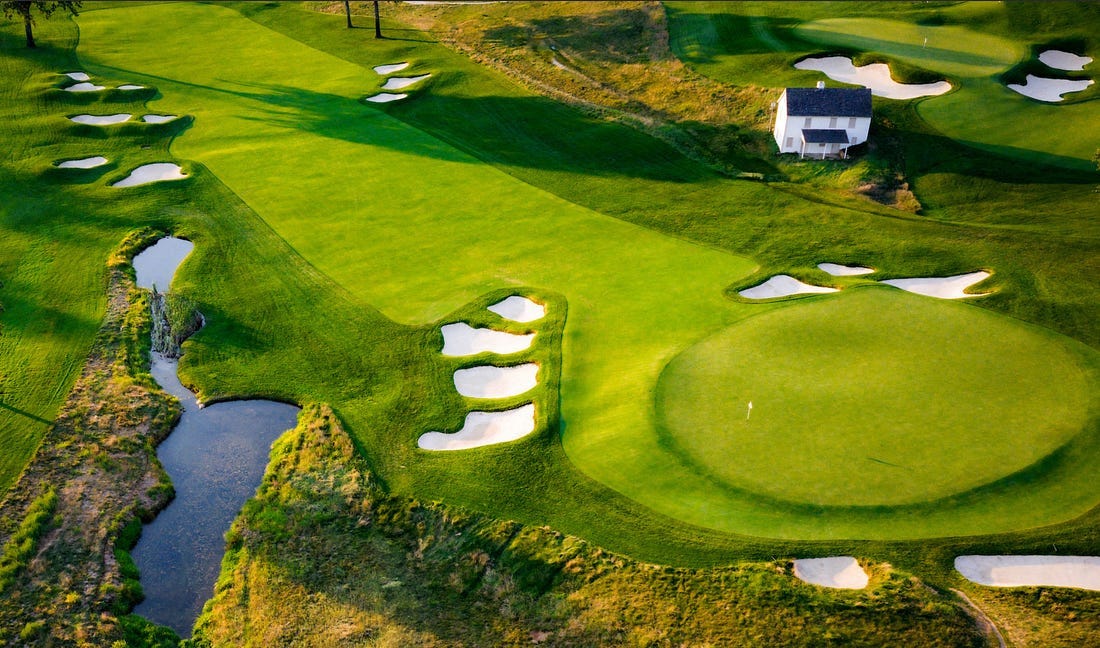
The PGA Tour is heading to the suburbs of Philadelphia for the second major of the year, the PGA Championship at Aronimink Golf Club.
The PGA Championship came into being in February 1916 when Rodman Wanamaker (the guy from the trophy) brought notable golf professionals together to establish the Professional Golfers Association of America. The first PGA Championship was played later that year in October as a match-play event.
The match-play era lasted until 1958, when the tournament was changed to a stroke-play event, following the familiar format of 72 holes over four days.
The event has moved around on the calendar since its inception. In recent times, it was played in mid-August. In 2019, it was moved to May as part of the restructuring of the PGA Tour schedule. It also moves around geographically, being played at a different course each year.
The tournament has a few other unique characteristics worth noting. It is one of the only tournaments for professional tour players that is run by the PGA of America (the others being the Senior PGA Championship and the LPGA Championship). It’s the only major that doesn’t explicitly invite amateur players, though they can qualify. It’s the only major that maintains invitations for golf club professionals, with the top 20 finishers at the PGA Professional Championship getting an invite each year. It also offers more special invitations than any other major.
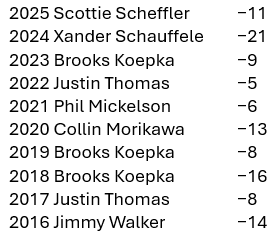
A wide range of scores have won at the PGA Championship. It can be one of the sterner tests of the year (Padraig Harrington won it at -3 in 2008), or one of the easier tests on tour. In 2025, Jason Day dismantled Whistling Straits, winning by 3 at -20 and two years, Xander Schaufelle birdied his final hole to avoid a playoff with Bryson DeChambeau and set the record for lowest score-to-par in major championship at -21. Over the past decade, winnings scores have primarily fallen between -5 and -16.
Last year at Quail Hollow, Scottie Scheffler shot the low round of the day on Saturday (65) to take a three-shot lead into the final round at -11. Scheffler was two-over after the opening nine on Sunday, and Jon Rahm was able to catch him briefly. Rahm played his final three holes at +5 though and fell back to 8th place. Nobody else threatened Scheffler’s lead and he finished right where he started with the lead at -11, five strokes better Bryson DeChambeau, Harris English, and Davis Riley (cutline: +1, median score for cutmakers: +1).
Here are the last 10 winners of the PGA Championship and their scores:
The Field
As a major championship, the PGA Championship has always attracted one of the strongest fields each season. It had had the strongest field every season since 2015, until two years ago when The Open beat it out by 3.1 points. The strength of field that year was 483.9 (second strongest of 44 tournaments; average was 275.6). Last year, the strength of field was 507.6 (1st of 46 tournaments; tour average was 280.0)
The field is set for 156 golfers, with two spots left to be determined; the winners of the Truist Championship and Myrtle Beach Classic will get an invite if not already exempt.
The run as one of the strongest fields of the season is likely to continue this year. Every single one of the top 104 golfers in the OWGR has committed to play. The 105th golfer, Thorbjorn Oleson, is the highest ranked golfer to not make the field. Tiger Woods and Phil Mickelson have elected not play, though they could if they wanted to.
The 20 PGA professionals that played their way into the field will be collectively known as the Corbridge Financial Team. Learn more about them here.
Here is a link to the full field.
Course Description
Founded in 1896, Aronimink is now located in Newtown Square just outside Philadelphia. Donald Ross built the club’s current 18-hole course in 1928 after the club relocated to what is now its fourth site, laying out a course across 300 acres of rolling farmland.
As you might expect from a course that’s been around for nearly 100 years, it is rich with history. My favorite fun fact that I came across while researching the course was that when President Dwight D. Eisenhower had a putting green installed at the White House, the turf came from Aronimink. Seems like a strange connection but the strain of bent grass that was used was developed by Professor H. Burton Musser, head of the turfgrass program at Penn State University, where the president’s brother, Milton, was president.
For a course that has been around for nearly a century, there have been surprisingly little elite golf tournaments played there. It was the host of the 1962 PGA Championship won by Gary Player (-2), the 2003 Senior PGA Championship won by John Jacobs (-4), the 2010 and 2011 AT&T National won by Justin Rose (-10) and Nick Watney (-13), the 2018 BMW Championship won by Keegan Bradley (-21), and the 2020 KPMG Women’s PGA Championship won by Kim Sei-Young (-14)
Over the decades, several architects have worked on the course, including Dick Wilson, George Fazio, and Tom Fazio. Most of their work focused on updating bunkering, lengthening holes, and adjusting greens and surrounds. No one fundamentally altered Ross’ routing, but collectively they slowly changed the course’s overall character.
Like many championship venues in the post-war era, Robert Trent Jones was brought into prepare the course for championship-level golf. He made the bunkering more difficult, narrowed landing zones, and increased emphasis on aerial target golf. This was a departure from Ross’ original design that emphasized a ground-game strategy.
In 2003, Ron Prichard completed a restoration project using Ross’s original drawings, which returned the greens to their original shapes and sizes and brought back Ross’ characteristic bunkering.
Gil Hanse and Jim Wagner were brought in for a major restoration ahead of the 2018 BMW Championship. They restored Ross’ original intent while dramatically increasing strategic complexity, especially around the greens and bunkering. Most notable, they added over 100 bunkers to the property (though many of the additions were simply splitting large bunkers into multiple bunkers). They also restored strategic playing angles by widening certain fairways, reintroducing diagonal lines of play, and allowing fairway contours to influence strategy.
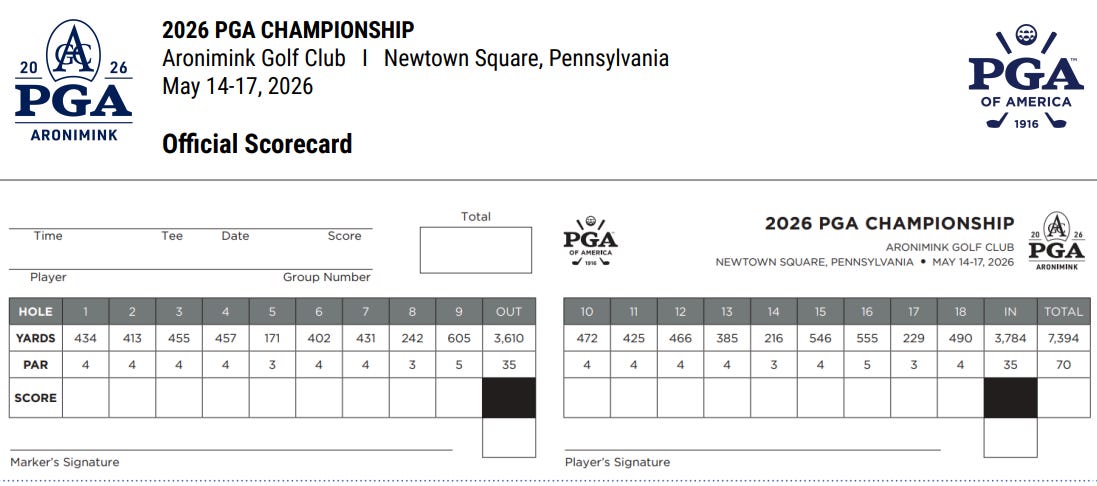
The course is now a 7,394-yard, par-70, classical design. By par, it is the 7th longest course on tour this year (out of the 38 courses I did calculations for). As host of the BMW Championship in 2018, it was the 7th easiest course on tour (out of the 37 that are ranked on DataGolf). It should be noted that the course was drenched by the remnants of a hurricane in 2018 and was extremely soft and scorable.
There are four par 3s, twelve par 4s, and two par 5s. One of the par 5s is 555 yards long and it is a realistic eagle opportunity if golfers put their tee shot in the fairway. The second par 5 is 605 yards and will need two good lashes to make birdie. There are two par 4s that should be a real test, the 546-yard 15th and 490-yard 18th. All of the other par 4s are under 472 yards in length, with one that is 385 yards with forward tee boxes that can be used to make it a drivable par 4. The par 3s is where the course gets its length; there is one that is just 171 yards, but the other three are all over 216 yards. In 2018, they were the 5th longest set of par 3s on tour and the 242-yard 8th hole was the most difficult hole on the course.
Here is the official 2026 scorecard:
Off the tee, golfers will see tree-lined fairways that are above average in width (average fairway width is 30 yards). The fairways are L-93 Bentgrass and the rough is a mix of Poa annua and tall fescue. The mowed area will be cut to 3.25 inches. There are only 19 m between the highest and lowest part of the golf course, but golfers will traverse 80 m of ascent during their rounds. The Fried Egg described the course as being built in a bowl; there are some holes that play uphill, others that play downhill, some play over valleys, and some play over ridges. Some of the holes play along the slope, so the fairways are tilted, making the effective landing areas feel even narrower. The slope is also used on create reverse camber on the doglegs, meaning shots will run away from the green unless golfers shape their shot against the contour. Golfers will also frequently face uneven stances, hanging lies, and approach shots from sidehill slopes. The elevation changes also create blind and semi-bling tee shots. There are bunkers in the landing zones, but professional golfers will be able to carry the bunkers on most holes. Bunkers are also used to create narrow stretches of fairway and create offset landing zones bringing an element of risk/reward off the tee where golfers will have to decide whether to take on the bunkers or lay up to a safer spot. There are also mounds and moguls, and areas where the native grass is allowed to grow unchecked. Water comes into play on two holes, but it’s used to protect greens rather than punish errant tee shots.
On approach, golfers will see large, bent grass greens (average is 8,200 sq. ft.). The hope is that they play firm and fast, but they are not equipped with sub-air systems, so any rain will make them slower and more receptive. They feature all the hallmarks of a Donald Ross design; they are elevated, significantly tilted from back-to-front and side-to-side, and feature heavy internal contouring with severe slopes, spines, swales, and shoulders that create segmented sections. While the size of the greens is large overall, all of the movement creates small targets. If golfers hit approaches into the correct sections, they can create excellent birdie looks. Miss those sections, however, and they will be left with difficult lag putts, putts over ridges, or defensive two-putts simply trying to escape with par. Positioning yourself in the fairway and setting up a good line into the greens will be critical to hitting the small targets. You will probably hear it mentioned that locals believe that nearly every putt subtly breaks toward the southwest corner of the property. They are also protected by the numerous bunkers and water on two holes. Most of the greens feature a narrow band of short grass around them followed by thick rough, though a few of the greens have closely mowed run-offs into collection areas. Most of the green fronts are open, so golfers should be able to play the ground game into them.
I’m reluctant to put any weight behind the statistics from 2018 when the course hosted the BMW Championship because the course was heavily impact by a deluge of rain, but I’ll share some of the notable statistics on DataGolf even though they probably won’t be all that relevant. Even though the par 3s were the fifth longest on tour, they were the 12th easiest on tour, the par 4s were the 4th easiest on tour, and the par 5s were the 8th easiest (out of the 37 courses). It was the 4th easiest in Strokes Gained: Off the Tee, 5th easiest in Strokes Gained: Approach, and 5th easiest in Strokes Gained: Putting. It had the second lowest Missed Fairway Penalty, fourth highest Greens in Regulation, and was the second easiest course on Approaches from over 150 yards. It also had the second fewest penalty strokes. It was also the easiest when putting from 5 to 15 feet. The only thing that was difficult was around the green play from the fairway, which was 4th hardest on tour.
The Weather
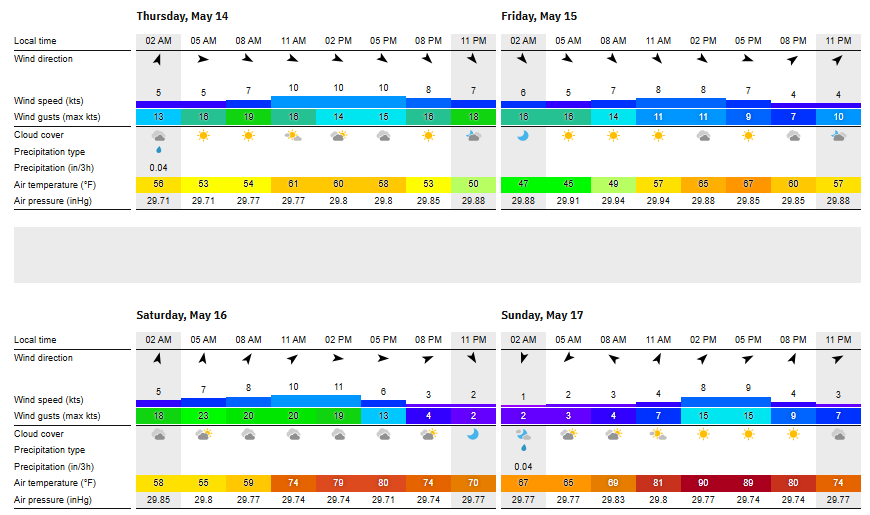
Weather will have a significant impact on how the course will play. If conditions are soft, the course could turn into a birdie fest because players will be able to attack pins aggressively. But if Aronimink firms up, it transforms into a classic Ross examination of strategic positioning and precise iron play.
As of now, it looks like there will be some rain today and then again on Wednesday night and maybe a little more on Sunday morning. Temperatures will steadily increase throughout the week, starting with highs in the 60s on Thursday and hitting the 90s on Sunday. The wind could play a role this week as well. They will start at 10 mph with slightly stronger gusts on Thursday and fall off a little on Friday. They will then ramp back up on Saturday with 20 mph gusts most of the day. They will then start off light on Sunday and build to 15 mph gusts as the leaders close out their rounds. This could be a good situation for a wave advantage, so we’ll want to play close attention leading up to the championship.
DFS Strategy
As always, the first thing to do is come up with our plan for the week, including bankroll usage, contest selection, leverage, and roster construction. I’ll then go over the type of golfers that I am targeting and the models I’ll use to find those golfers.
Unfortunately, since we’ve only seen this course played a few times, and one of those times it was exceptionally soft and gettable, we just don’t have much data behind the metrics we usually use to determine how much bankroll we’ll want to use. Instead, I think we have the same two thoughts we have with all the majors to consider (outside of the Masters). First is the issue of being at a course that we see infrequently. The second is that this is a major! Contests will be bigger, meaning bigger payouts, and of course, the general excitement of all the top players in the world getting together to duke it out. If this was any other week, I would say be a little cautious with your bankroll, but I know it’s hard to ignore the fact this is a major. Instead, I’ll split the baby and say play your usual bankroll unless you’re comfortable taking on extra risk to chase the big pay outs.
Unlike a standard PGA Tour event, or even the signature events, there is nothing run-of-the-mill about the majors. There are two Millionaire Maker contests for the PGA Championship: one with a $4,444 entry, and one with a $25 entry. Contest sizes are also going to be bigger; the contests I usually play are between two and three times their usual size. If you like the contests that you usually play and don’t want to face a bloated field, you can always look out for a secondary or tertiary version of the contests. Although it feels like I have a pretty good read on how the course will play, we can’t be certain because we have only seen this course a few times. Due to this uncertainty, I would avoid the 50/50s and doubles up and focus on the GPPs.
Once you have decided which contests you will be playing in, we need to decide how much leverage we want and how we’re going to get that leverage.
I don’t have any cumulative ownership data from past events at Aronimink to help make our determinations on leverage, but I do have data from the last two PGA Championships. In those Birdie contests, the winners had 53% and 65% cumulative ownership. We know contest sizes will be larger, so we need try to get a little more leverage than we usually get, and I would aim for 65% cumulative ownerships for my lineups. If you are going to opt to play in the secondary or tertiary contests, those sizes should be more inline with what you typically play, and I would just use my standard 65% to 95% cumulative ownership target as a guide. In these contests, you’ll need to get just enough leverage to make sure your lineups are unique.
As always, we have the same three places we turn to for leverage every week. The first is the ownership projections, where we will try to identify the chalk and then look for good pivots off the chalk. We can also us the projected ownership to figure out what the popular roster constructions are going to be and then figure which constructions will lead to unique combinations of golfers. We can then look at the pricing; identify golfers that are priced too low and consider fading them because they will likely be over-owned and identify the golfers that are priced too high and give them consideration because the DFS community will try to avoid them.
Being a major, I think most DFS players will go with stars-and-scrubs lineups or super stars-and-scrubs lineups. Whenever you build super stars-and-scrubs lineups, you have to include a couple of low-priced golfers in your lineups. If you avoid the chalk in the low range, you should automatically get some leverage without having to consider the ownership of your other golfers.
If you want to get leverage with a stars-and-scrubs build without having to roster the low-owned golfers, you can get creative with the stars-and-scrubs construction instead of just using the standard stars-and-scrubs build (one 10k, one 9k, one 8k, two 7k, and one 6k golfer). By going with one of the alternative builds, you will get some leverage by putting together unique combinations of golfers.
Balanced lineups will be the real leverage play though. Given the talent in the field, I doubt very many DFS players will be building balanced lineups, and you will be highly leveraged with these lineups.
I normally don’t recommend leaving money on the table at full field events, but if you are playing one of the bigger contests, like the $25 Millionaire or the Drive the Green (both over 100k entries), you may want to consider it. Since most DFS players will try to use all or close to all of their available salary, you only have to leave around $500 on the table to ensure you are putting together unique combinations.
As I will describe shortly, I don’t think Aronimink is the type of course that favors any one type of golfer, so DFS players probably aren’t going to target a specific type of golfers. So, I don’t think we’ll be able to get leverage by pivoting off of the popular type of golfer.
Once you’ve decided which contests you want to play and how you’re going to get leverage, you can start thinking about roster construction. So, turning to the Roster Construction Matrix, we have the strongest field on tour at a course that will vary in difficulty based on the weather. Since it looks like there is going to be rain, I’ll say this is an average difficulty course. The matrix points towards stars-and-scrubs builds. Pricing is already out, so you can start tinkering today. We’ve got Scottie at 13.9k and Rory at 12.4K, but then there are five options from 10.0k to 10.9 k. DraftKings has also brought back the 5k price range, and there are definitely some golfers in that range I would consider (Alex Fitzpatrick is 5.9k and on an incredible heater right now). So, we have the pricing flexibility to build super stars-and-scrubs lineups if we want; I recommend trying to build a few before settling on a lineup choice.
My plan this week is to stick to my usual bankroll and focus on 20-entry GPPs and single-entry contests. I went a little hard for the Masters, but I just don’t have the same excitement for the PGA. I will build mostly stars-and-scrubs lineups and mix in a few super stars-and-scrubs. Since we have the 5k range this week, DFS players will be able to build lineups with Scottie and Rory that aren’t that gross, so I think you may be able to get leverage by building stars-and-scrubs lineups with one of the 10k golfers instead, so I’ll consider building those lineups as well. I’ll play the chalk that I like, but I will have enough low-owned pivots and golfers with less than 3% ownership to keep my projected cumulative ownerships around 65%.
The only winners that we have at Aronimink in the modern era are Keegan Bradley, Justin Rose, and Nick Watney; two ballstrikers and a plodder. On paper, it appears long, but the course is much more about angles, slopes, and approach precision over brute force. The terrain constantly shifts direction, creating uneven lies and forcing players to think carefully about positioning off the tee. Driving distance helps on certain holes and bombers can overpower portions of the course, but this is not an overwhelmingly bomber-friendly setup. Instead, the course seems to favor elite iron play, strong lag putting, and comfort on heavily sloped bent grass greens (I’m thinking guys that putt well at Augusta).
I think everybody has a reasonable path to victory here. Since a lot of the distance of the course is wrapped into the par 3s, the plodders aren’t going to be too far behind on the par 4s and 5s, they will just have to keep the ball in the fairway and be proficient with slightly longer irons. The same can be said for the ballstrikers, but they should have shorter irons in their hands most of the time and have even better looks at attacking pin locations. For both of these golfers, it’s all about keeping the ball in the fairway and laser-like precision with their irons.
The bombers won’t lose too much ground if they miss the fairways because they will be playing with short irons and will be able to attack pin locations even from the rough, especially if the course is softened by rain. The rough is fairly uniform and there isn’t any water on the course, so wide misses won’t be punished more than small misses. If a bomber is locked in and hitting fairways, they could easily run away with this tournament.
Since most of the area surrounding the greens is going to be thick rough, short game prowess is a bit neutralized. I don’t think we need to target short game specialists, leaving golfers like Viktor Hovland as options as well.
I think a variety of styles can be successful off the tee and golfers will separate themselves with elite iron play. The tournament will then come down to whichever golfer hitting their irons well also gets hot with their putter.
As usual, I will start my process by building my models and putting together the Recent Form and Course History spreadsheet. I will use my model to target golfers that keep the ball in play off the tee, are strong on approach with their short and mid irons, and putt well on fast greens. I’ll also be looking for golfers that can make a lot of birdies, can take advantage of the par 4s, and survive the long par 3s.
We only have one year of Course History that I think is relevant. The two PGA Tour stops in the early 2010s are so long ago that I doubt many golfers in this field were even playing back then. While 2018 is a little more relevant because there is more crossover between the two fields, the course played so differently due to the rain than it will this time, that I am not going to put too much consideration into those results. I will include them in the spreadsheet though, just so I have an idea if the golfer has seen the course or not.
I am also going to place a little more emphasis on Recent Form this week. Even though I don’t think this is going be very difficult challenge in relation to most majors, I still want my golfers to be coming in with good form and not trying to find their game.
Here are the course fit statistics that I will be using (all from the last 100 rounds):
Off-the-tee:
Strokes Gained: Off the Tee: A staple in my model most weeks, I will usually add another off-the-tee statistic to fit the specific course.
Driving Accuracy: While I think any style off the tee can work at Aronimink, I am going to lean more towards accuracy. The fairways are wide enough that the more accurate golfers should be able to establish an edge off the tee. Whether the greens are firm or softened by rain, playing from the fairway gives golfers a better chance to hit their target on approach. If there is a lot of rain, preferred lies could be in play, giving an advantage to go the golfers keeping it in the fairway.
Approach:
Strokes Gained: Approach: A staple in my model week after week. This is almost always the most important statistic, but I will it a little extra weighting this week because I will be downgrading around-the-green play.
Proximity from 100-150 yards: With half of the holes on the courses playing between 400 and 500 yards in length, I think a good proportion of approach shot will come from this range.
Around-the-green:
Scrambling from the Short Grass: While I think around-the-green skill is neutralized a lot by the thick rough around the greens, there will be some scrambling from the short grass, which can be challenging. I want to give an edge to golfers that handle these tricky shots well.
Putting:
Strokes Gained: Putting on Bent Grass: Another staple in my model week after week, I will switch up the surface as needed. This week we’re looking for bent grass specialists.
Scoring:
Birdies or Better Gained: I think the rain is going to soften the course and create prime scoring conditions. It may not be a birdie fest like 2018, but even in 2010 and 2011, golfers needed to be double digits under par, so I wouldn’t be surprised if the winner is -15 to -17 this week.
Par 4 Efficiency 401-500 yards: Nine of the holes on the course fall in this range. Golfers that can take advantage of these holes will have a big edge since there aren’t many other scoring opportunities otherwise with just two par 5s.
Par 3 Efficiency 200+ yards: The long par 3s give this course some of its only bite. Golfers will need to survive these holes in order to contend.
I will also build a model that includes statistics that are only available using The Rabbit Hole on Betsperts.com. I use this model to look at specific challenges of a particular course or fill in the gaps of my main model. For the PGA Championship, this model will include Strokes Gained: Off the Tee at Long Courses, Strokes Gained: Approach on Courses with Bent Grass Fairways, Proximity from 200+ yards, Sand Save %, Putting from 25+ feet, Par 5 BoB%, Strokes Gained: Total at Donald Ross Courses, and Strokes Gained: Total at the Majors.
In short, I am looking for golfers that keep the ball in play off the tee, surgical with their short to mid irons, and are comfortable putting on bent grass. The statistics that I will be focusing on to start my player pool are Strokes Gained: Off the Tee, Driving Accuracy, Strokes Gained: Approach, Proximity 100-150 yards, and Strokes Gained: Putting on bent grass.
That’s all I have for now, be sure to follow me on Twitter (@glzisk) for any updates.