
The Fringe
PGA DFS preview: Rocket Classic and Detroit Golf Club

Good morning, Fringe readers!
I’ve been busy getting up to speed on all the changes made to Detroit Golf Club, host of next week’s Rocket Classic, and don’t have much else to communicate, so let’s dive in.
It could be the last time we see the club, so soak it in!
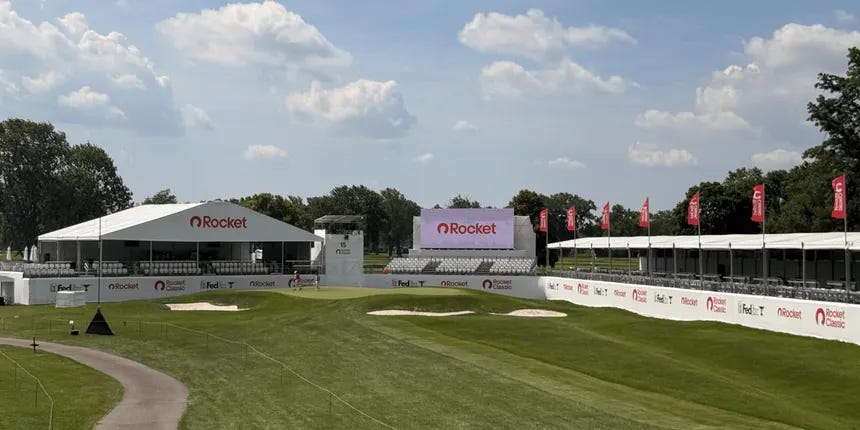
The PGA Tour is staying in the Midwest for the Rocket Classic at Detroit Golf Club.
The Rocket Classic is one of the newer tournaments on tour, played at one of the oldest courses on tour.
It had been known as the Rocket Mortgage Classic since its origin, but the name was changed as part of a bigger rebranding project by the title sponsor.
The tournament made its first appearance in 2019, when it replaced the Quicken Loans National on the PGA schedule. It quickly earned the reputation of being a birdie fest with winning scores usually bettering -20. In 2021 and 2024, the only years the winning scoring didn’t reach -20, the course was hit with 20+ mph winds, but scores still hit -18.
During its brief history, the tournament has always been played at the same location, but it has moved around on the calendar. The first three editions were played in late June/early July. The tournament was then moved to the end of July in 2022, serving as the penultimate event of the season. It then moved back to its previous spot in 2023. It has shifted again this year, back to the end of July and once again the penultimate event of the regular season.
Veteran-grinder Nate Lashley (-25) won the first edition after getting into the field as the third alternate. Bryson DeChambeau (-23) overpowered the course to take the trophy in the 2020 edition played without any fans in attendance. In 2021, Cam Davis (-18) prevailed in a playoff over Joaquin Niemann and Troy Merritt. In 2022, Tony Finau (-26) routed the course and the field, winning by five strokes over Patrick Cantlay, Taylor Pendrith, and Cameron Young. In 2023, Rickie Fowler (-24) beat Collin Morikawa and Adam Hadwin in playoff for his first win since 2019. And in 2024, Akshay Bhatia three-putted from 32 feet to drop a shot on the final hole and hand Cam Davis (-18) his second win in Detroit.
Last year, Aldrich Potgieter entered the final round with a two-stroke lead over Max Greyserman, Chris Kirk, Jake Knapp, Mark Hubbard, and Andrew Putnam. As the leaders came to the closing holes, Potgieter, Greyserman, and Kirk were all tied for the lead at -22 (cutline -6; median score for cutmakers: -12). Potgieter and Greyserman had putts on their 72nd hole that would have won them the tournament, but both failed to convert, and the three men were off to a playoff. On the second playoff hole, Chris Kirk missed a short putt to match the other two golfers and was eliminated. On the subsequent holes, both men had mid-range putts to win but couldn’t find the bottom of the cup. Finally, on the fifth playoff hole, they both reached the green in regulation but Greyserman two-putted from 34 feet for par, while Potgieter was able to convert an 18-foot putt for birdie to get the win.
Rocket Companies has not renewed their sponsorship of the event for 2027. The PGA Tour is interested in remaining in the Detroit area, but without a sponsor, it hard to see how the event can continue.
The field
As a filler event between majors, the Rocket Classic has never drawn awe-inspiring fields; not the worst, but not the best either. Even as a last-minute tune-up for the playoffs a few years ago, the strength of field didn’t improve. Two years ago, the field maintained its customary position towards the middle of the pack with a strength of field at 238.6 (29th strongest of 44; average was 275.6).
Last year, the strength of field was 275.3 (21st strongest of 46 tournaments; average was 280.1).
The 2026 field is set for 145 golfers, but as usual this season, if Brooks Koepka stays in the field, it will be expanded to 147 to accommodate threesomes. There are still four open qualifiers yet to be determined.
Last year, the tournament saw a noticeable increase in the strength of field due to the fact that five golfers inside the top 25 in OWGR showed up to Detroit (in the past, the tournament was lucky to get one or two. This year the tournament could see another uptick in strength with nine golfers from inside the top 25 in OWGR, including four from inside the top ten: Cameron Young, Russell Henley, Chris Gotterup, and Wyndham Clark. Aldrich Potgieter will also be back to defend his title
Joe Hook is in the field as a sponsor exemption after winning the John Shippen National Invitational Golf Tournament.
Here is a link to the full field.
Course Description
The Detroit Golf Club dates back to 1899 when it opened as a 6-hole course. Donald Ross began working on the property in 1913, and in 1916 the club was expanded to its current 36-hole design separated into the North and South Course.
Prior to the founding of the Rocket Classic, no professional golf had been played at Detroit Golf Club. The only events of significance the course had hosted was the 1911 Western Amateur and the 1992 U.S. Mid-Amateur.
Throughout the 2010’s, the club worked to bring the courses up to the standards of the PGA Tour. There was a large renovation led by Bruce Hepner that restored the greens and bunkers, lengthened the course, and brought back elements of the original Donald Ross design.
Ahead of the 2023 edition of the Rocket Classic, the greens on holes 11 and 12 were completely resodded after they were vandalized just one month before the event.
The following year, a large renovation project was initiated. Ahead of the 2025 edition, a new storm drainage system was installed, new pumping stations were constructed, and a new mainline irrigation system was installed.
Ahead of this year’s edition, more work has been done, led by architect Tyler Rae, a Donald Ross specialist, with the goal of restoring many of Ross’s original strategic concepts. The greens were completely reconstructed and reshaped using Donald Ross’s original plans, restoring them to their historic elevations and contours. The bunkers were also restored to Ross’s original strategic intent. Some of them were relocated, fairway bunkers were designed with increased visibility from the tee in mind, some were rebuilt with steeper faces, and their sharp edges were restored. Every tee box was rebuilt with numerous championship tee options. Many fairways were made slightly wider. Trees were removed to restore Ross’ sightlines, improve turf health, increase wind exposure, and reintroduce strategic angles. And the rough surrounding many greens was removed and converted to tightly mown collection areas and shaved runoffs.
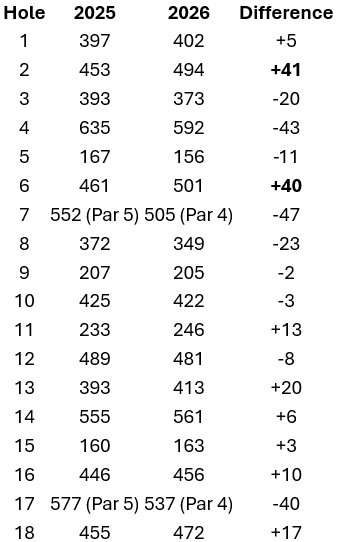
All of the changes have resulted in significant changes to the scorecard. The course, while becoming 42 yards shorter, actually lost two strokes of par. Two par 5s became par 4s, hole 7 is now a 505-yard par 4, and hole 17 is now a 537-yard par 4. Almost every hole had its yardage changed, some shorter, and some longer; most notable is the 41-yard increase to hole 2, making it a 494-yard par 4, and the 40-yard increase to hole 6, making it a 501-yard par 4. Here is complete rundown of the changes:
The course used for tournament play is a 7,328-yard, par-70, classical design. By par, it is now tied with Torrey Pines as the longest course on tour (out of the 38 courses I’ve done the calculations for). Last year, it was the 2nd easiest course on tour (out of the 40 courses that are ranked by DataGolf).
The course played during the tournament is technically a composite, but only one hole from the South Course is included in the routing. The 8th hole and 9th of the North course serve as the first two holes. The 3rd hole is the 1st hole from the South course, but it uses the tee box from the 1st hole on the North Course. The rest of the front nine is holes 2 through 7 and the regular back nine is the back nine for the tournament.
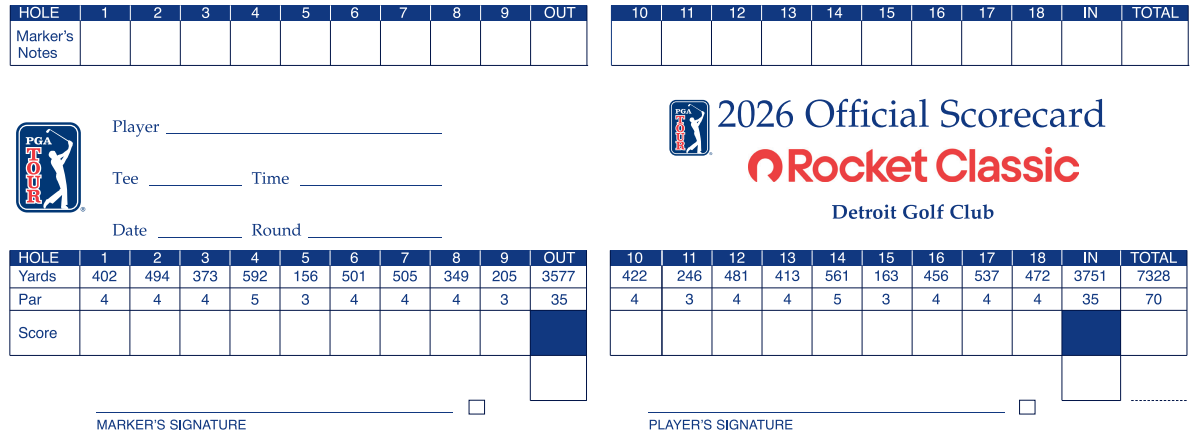
It is now a par-70 course with four par 3s, twelve par 4s and two par 5s. The two par 5s that still exist were the 3rd and 4th easiest holes on the course last year (the two that disappeared were the two easiest holes). The set of par 4s were the fourth easiest set of par 4s on tour last year, but that should change now that three of them are over 500 yards in length and one a hair shy of 500 yards. The par 3s haven’t changed much, there are still two of the par-3s are under 170 yards, and the other two are still over 200 yards, but one is now 246 yards.
Here is the official scorecard for 2026:
Off the tee, golfers will see wide tree-lined fairways (35.4 yards wide according to DataGolf, 11th widest out of 40 courses on tour last year), though it sounds like they may be a little wider this year. The rough is a bluegrass mix that is kept at 4 inches in length. The fairways are a mix of bent grass and Poa annua. There are bunkers in the landing areas, but the only water on the course was removed during the renovation. The bunkers were repositioned during the renovation to be more visible from the tee, and hopefully, cause golfers to think more strategically in the tee box. The trees are pushed back from the fairway on most of the holes and should only be an issue on the most wayward drives, but there are some narrow chutes and a few instances of overhanging trees crowding the fairway and requiring some shot shaping. The course is one of the flattest on tour with only 12m of difference between the highest and lowest points. The 18th hole features a drainage ditch that runs along the left side of the fairway, crosses the fairway, and runs along the right side of the green; it shouldn’t be much of an issue, but it is considered a penalty area.
On approach, golfers will be hitting into average-sized (6,700 sq. ft.), receptive greens that feature the back to front pitch characteristic of Donald Ross designs. The surface is a mix of bent grass and Poa annua, though they were completely resurfaced during the renovation and probably closer to pure bent grass since the Poa hasn’t had time to invade the greens. The new greens will likely be a little firmer than usual as well. They are protected by bunkers, false fronts, shaved run-offs, and tightly mowed collection areas. The bunkers didn’t provide much protection as they are situated to the sides of most greens, leaving the fronts open, but they’ve been rebuilt with steeper faces so golfers will at least have a harder time scrambling if they end up in a greenside bunker. The pond protecting the 14th green was removed during the renovation and replaced with fescue. The greens are elevated and are multi-tiered and contoured with lots of undulation and well-defined quadrants, meaning golfers will have to be accurate on the approach if they want to make birdies. I have seen the speed of the greens listed as 10.5 to 12.5 on the stimp meter (10.5 being slow and 12.5 being relatively fast). The discrepancy comes from the fact that the hot, dry conditions of summertime in the Midwest forces the grounds crew to water the greens between rounds. The greens start out soft and slow, but get firmer and faster throughout the day, so they are quick when the TV broadcast starts. With greens that are sloped back to front, can run fast, and have subtle breaks to them, golfers will want to do their best to put their approach below the hole.
In the past, since the tournament usually turned into a birdie fest, the greens at Detroit Golf Club were a big factor determining the outcome of the tournament, the long rough, however, was the main defense of the course. Compared to other courses on tour, however, hitting the fairways has been easy to average (Driving Accuracy was 65.5% last year; 7th easiest of 40 courses on DataGolf). And it’s not because golfers are electing to club down to hit the fairway, Driver usage was 86% last year (tour average was 69.8%) and Driving Distance last year was 301.7 yards (5th longest of 40 courses on DataGolf). The greens were also relatively easy to hit, Greens in Regulation last year was 73.5% (5th easiest of 40 courses on DataGolf). If a golfer is unfortunate enough to miss a green, they shouldn’t have too much trouble saving par (Scrambling Percentage was 64.7% last year, tour average was 58.9%). So, with easy to hit fairways and greens, the Rocket Classic usually came down to a putting contest. As I will explain, I think that will be different this year after the renovation.
A deeper dive into the DataGolf Course Table highlights just how friendly Detroit Golf Club has been. Last year, it was the 5th easiest course for Strokes Gained: Off the Tee, the 7th easiest for Strokes Gained: Approach, and was the 4th easiest on approach from over 150 yards. There also wasn’t much of a penalty for mistakes; it had the 2nd lowest Missed Fairway Penalty, 4th lowest fraction of missed fairways that results in a penalty and 3rd lowest penalty strokes per round overall.
Weather
In most years, the weather conditions for the tournament are hot and dry, to the point that there is a lot of roll out in the fairways and the greens have to be watered. In the 2021 edition of the tournament, there were rains during the tournament that softened the greens, but there were also high winds to keep scoring down. In 2023, there was rain during the week leading up to the tournament and rain over the weekend, so much so that the final round was started early to get all the golf in before inclement weather could stop play. Two years ago, we saw periods of 20 mph gusts and scoring was down off its usual highs. So, it appears high winds are the only thing that could keep scoring under -20.
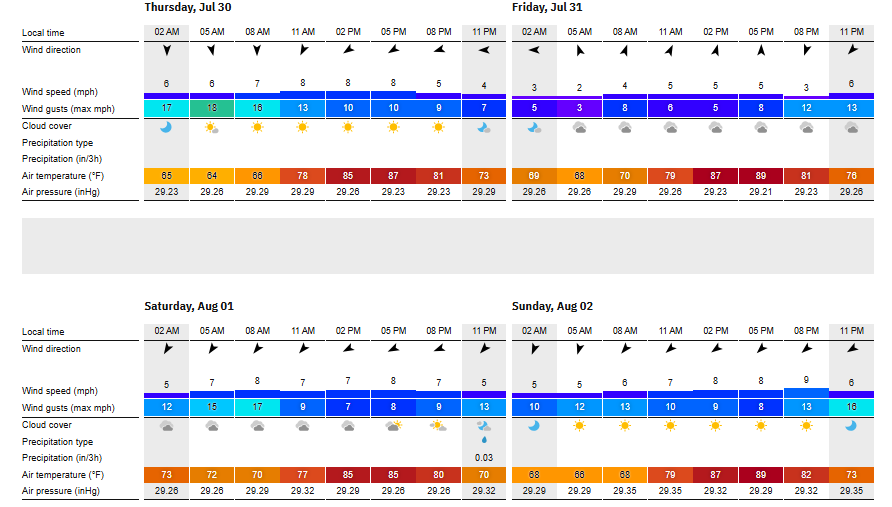
As of now, there is a small amount of rain in the forecast on Tuesday morning and just a sprinkle on Sunday morning, but temperatures in the 80s and a little wind should dry the course out quickly. Highs will be in the 80s during the tournament, with mostly cloudy skies. Sustained winds will be under 10 mph for the duration of the tournament, but there will periods of gusts over 10 mph. Wind doesn’t look like it should be much of a factor this year, but firm conditions should make the course a little tougher after the renovation.
DFS Strategy
Unless the wind plays an outsized role at the Rocket Classic, the tournament tended to devolve into a putting contest. Putting contests can be difficult to predict from a DFS standpoint. Unlike difficult courses that are unpredictable because a bad hole or two can knock golfers out of the tournament, easy courses are unpredictable because they don’t knock anybody out of the field. They even the playing field for the less talented golfers. Everybody hits the fairways and greens, so it comes down to who is putting the best. High-end talent can be solid from tee-to-green but play themselves out of the tournament with poor putting while the guys that usually struggle from tee-to-green can find themselves in contention by getting hot with the putter.
Just look at the list of winners; Cam Davis is regularly priced in the low 6ks after winning the Rocket Mortgage twice, it took Nate Lashley 12 years to reach to the PGA Tour after going pro, and Rickie Fowler was a shell of himself when he won the Rocket Classic. Akshay Bhatia is a talented golfer, but not too many people would call him elite. Bryson is really the only top golfer to have won in Detroit. When anybody can win a tournament, it makes it very difficult to predict.
The chalk has also had mixed experiences at the Rocket Classic. Some of the chalk usually performs very well. Some of the chalk always struggles though with some notable names missing the cut each year. Sometimes they just have an off week, and other times they just don’t putt well enough to keep up. It was another mixed year for the chalk at the 2025 Rocket Classic. There was only one chalk golfer in the top ten, but only two chalk golfers that missed the cut and a lot of chalk right in the middle. I would say this is somewhat unpredictable; the chalk has performed well (Akshay and Rickie were chalk when they won), but it has missed a lot of cuts or had lackluster finishes.
Detroit Golf Club is one of the least volatile courses on tour. There just aren’t many Penalty Strokes or Reloads, so golfers can’t play themselves out of the tournament on a couple of bad holes. This puts the tournament on the more predictable side.
According to the Course Insights page for the Rocket Classic on DataGolf, Detroit Golf Club has slightly favored bombers once, slightly favored accuracy twice, and has been neutral four times. This is another indicator suggesting anybody can with in Detroit, making it an unpredictable event.
The slope of the DataGolf Strokes Gained: Total vs. Predicted regression for the Rocket Classic has been under 1 for every year of its existence (it was close to 1 a couple of times, but still under 1). This means that highly skilled golfers separated less from lower-skilled golfers than they do at a typical PGA Tour course. Once again, anybody can perform well at Detroit Golf Club, making it an unpredictable event.
In the past, due to the fact that this tournament could turn into an unpredictable putting contest, some of the chalk usually blows up, and highly skilled golfers have been unable to separate themselves, I would recommend holding back some bankroll for the Rocket Classic. All of the changes made to the course could change that though; the course is longer, it should make golfers think more strategically off the tee, require more precision on approach, and the changes around the green should favor a strong short game. We just don’t know if the changes will actually have that impact. So, until we find out if the renovation has changed the nature of the course, I think we can stick with holding back bankroll if we’re uncomfortable.
The Rocket Classic is one of those run-of-the-mill events that I regularly allude to throughout the season. DraftKings will still run its full slate of contests; double-ups, 50/50s, single-entry contests, GPPs, and Millionaire Maker qualifiers, but the GPPs will be smaller. If they are too small for your liking, you can always find a bigger contest (unless you’re already in the biggest contest). Check the lobby early in the week so you can come up with a new plan if necessary. I would avoid 50/50s and Double Ups until we learn more about how the course will actually play.
Once you have decided which contests you will be playing in, we need to decide how much leverage we want and how we’re going to get that leverage.
Looking at the results from the last few of years, cumulative ownerships have been all over the place. Winning lineups are usually around 80%, but there are a few instances of them being over 90% and the winner of the Birdie contest last year was 62%. Which makes sense; we’ve seen longshots win, we’ve seen the chalk win, and we’ve seen mixed results from the chalk overall. I think we just need to keep our cumulative ownerships in my recommended range of 65% to 95% in our GPPs (you can go a little higher in your cash games). Which isn’t a ton of leverage, particularly at the upper end of the range; just a little leverage should do. If you get a feeling the chalk will perform well, or we’re going to get a longshot winner, you can skew your ownerships towards either end of the range.
As always, we have the same three places we turn to for leverage every week. The first is the ownership projections, where we will try to identify the chalk and then look for good pivots off the chalk. We can also us the projected ownership to figure out what the popular roster constructions are going to be and then figure which constructions will lead to unique combinations of golfers. We can then look at the pricing; identify golfers that are priced too low and consider fading them because they will likely be over-owned and identify the golfers that are priced too high and give them consideration because the DFS community will try to avoid them.
I also think PGA DFS players will see DeChambeau, Davis, and Finau on the short list of winners at the Rocket Mortgage and try to target the bombers this week, especially after all of the changes made to the course and seeing it now plays longer. The plodders will likely go overlooked, but Nate Lashley was able to get a win here. They will have to depend more on their mid- and long-irons than the bombers will, so check their proximity numbers from the longer distances if you are considering any of them.
PGA DFS players will also see the winning scores and target the birdie makers and rostering a grinder or two can get you some leverage. This could be particularly useful if scoring has been made more difficult by the renovation of the courses.
If you want to get leverage through roster construction, you have a few other options as well. DFS players tend to go with stars-and-scrubs lineups most of the time. I think we can get leverage by building balance lineups, and considering the type of course and strength of field, they could be a viable option on their own this week.
If you still want to build stars-and-scrubs lineups, you can get leverage by building non-standard versions of the stars-and-scrubs lineup like we’ve discussed in the past. By switching up the roster construction, you are more likely to put together a unique combination of golfers. An easy way to do this is by simply skipping one of the salary ranges.
The third way to build unique combinations using roster construction is by using less than the total salary available to you. Most DFS players will try to use all of their available salary, or at least most of it. By leaving some salary on the table, you’re also likely to be putting together unique combinations.
Once you’ve decided which contests you want to play and how you’re going to get leverage, you can start thinking about roster construction. So, turning to the Roster Construction Matrix, we have a medium strength field on an easy course. The matrix points us towards a balanced build. If the changes to the course actually give it some teeth and make it a medium difficulty course, the matrix also brings stars-and-scrubs into play. There are at least a couple legitimate stars in the field though, so I would give the stars a good look before settling on a roster construction. With the caliber of stars in the field this year, I think both roster constructions are viable. Indeed, stars-and-scrubs and balanced line-ups won contests last year for the Rocket Classic. Most winning lineups have been stars-and-scrubs though, a super stars-and-scrubs lineup has won at the Rocket Mortgage too. So, I think roster construction is wide-open this but, but I’ll have to see what the 6k options look like before considering a super stars-and-scrubs build.
My plan this week is to stick to my usual bankroll and focus on GPP contests, probably 20-entry and single-entry contests. I’ll probably have an even split between stars-and-scrubs lineups and balanced lineups, but that could change if I see anything odd about the pricing. I’ll be a little cautious with how much chalk I play but I won’t avoid the plays I really like. I’ll also try to get a few sub-5% golfers in my pool. I also won’t be targeting bombers or golfers that excel at birdie fests, so I should get some leverage that way. I will also be sure to keep my cumulative ownerships between 65% and 95%. Since I won’t be venturing out on the risk curve too much this week, I’ll probably have 3-5 one-offs.
Now that we have a plan for the week, we can focus on the type of golfers we will target.
I’ve mentioned that, in the past, the Rocket Classic usually turned into a putting contest. Putting, however, is volatile and hard to predict, so the best we could do was try to find golfers that could position themselves to win a putting contest. Anybody could compete in a putting contest though; bombers could bomb and gouge their way around Detroit, but it wasn’t so long that the plodders couldn’t keep up. So, I would recommend a two-pronged approach to building my player pool. On one side, I try to identify the best ballstrikers and hope they have a good week putting. The other side was identifying the best putters in the field and then confirming that they are capable of occasionally ballstriking well. I think the renovations, however, require us to change our approach.
The renovations were designed to restore the strategy and skill needed to navigate a Donald Ross design. The long hitters will no longer be able to bomb and gouge their way around the course; contoured and undulating greens surrounded by short grass mean golfers will have to leave themselves in good position for their second shot, while avoiding the relocated bunkers. The additional length also means that the plodders will struggle to keep up and will rely more on their long irons. So, golfers will need to think strategically off the tee, combining both distance and control. The new green complexes will also put a greater emphasis on iron play.
Given the complexity of the greens and toughened around the green play, not only will strong iron play be rewarded, but a strong short game as well. The rough around the green levelled the playing field since it was difficult for everybody to play from, but the new short grass, while still difficult, will allow golfers to separate themselves with a strong short game. Chipping from the rough is all based on the lie, and therefore more random. Golfers just tend to hack it out and hope for the best. Chipping from short grass gives golfers more control, meaning skill can actually be rewarded.
I expect the scoring will be down a little this year; not only does it appear the course will play tougher, but two easy par 5s have been replaced by monstrous par 4s. That change alone should keep the winning score from reaching -20. Given the diminished scoring opportunities and how difficult 500+ yard par 4s play, I think the winning score will likely end up around -15. Instead of targeting golfers that can take advantage of par 5s, we now need to identify golfers that can survive long par 4s.
Overall, instead of targeting golfers that can contend in a putting contest, we need to target golfers that keep that ball in play of the tee, are strong on approach, and are good around the greens.
As usual, I will start my process by building my Course Fit model and putting together a Recent Form and Course History spreadsheet. I will use my model to target golfers that are long and straight off the tee, precise with their short- mid-irons, and can scramble on short grass. I will also look for golfers that can handle long par 4s and play well on Donald Ross designs.
I will then put together my Predictive model.
Course History was never very predictive at Detroit Golf Club, according to DataGolf, but given the extent of the renovations, it’s probably useless now. I’ll include Course History on the spreadsheet, but I probably won’t look at it very much.
Off-the-tee:
Total Driving: I really want golfers that are long and straight. The course is long, so a little distance is helpful. It also has wider fairways and golfers will be trying to play to a specific part of the fairways, which accurate golfers can take advantage of. I will look at this statistic on long/very long courses.
Approach:
Strokes Gained: Approach: A staple in my model week after week; these statistics will continue to be the most heavily weighted statistics in my model. I will look at this statistic on long/very long courses.
Proximity 150-200 yards: By my count, about half of approach shots will come from this range. Golfers will need to be proficient with their short- and mid-irons to contend at the new Detroit Golf Club.
Around the Green:
Scrambling from Short Grass: The course should play longer and tougher this year, leading to more missed greens. Since much of the rough around the greens has been removed, golfers that are able to scramble well from the short grass should have an advantage.
Putting:
Strokes Gained: Putting on bent grass: Putting is another staple in my model; I will switch up the surface as needed. This week, I will be looking for golfers that perform well on bent grass.
Scoring:
Strokes Gained: Par 4s 500+ yards: Three of the holes on the course are now par 4s over 500 yards in length and one is 494 yards. Golfers better be able to hold their own on these holes.
Bogey Avoidance: With fewer scoring opportunities overall, golfers can’t give too many strokes back if they want to stay in the mix. Particularly on the three par 4s over 500 yards, golfers will be staring at potential bogeys more often than they would like, they better be ready to save par on those holes.
Strokes Gained: Total on Donald Ross Courses: Donald Ross is one of those architects whose designs some golfers just seem to perform better on, while others seem to struggle. I want to roster golfers that enjoy the challenge of a Donald Ross course.
Some of the other statistics that I am interested in and will include on the spreadsheet but not in the Course Fit model are:
Strokes Gained: Total on Driver-Heavy Courses: At 86% driver usage, Detroit Golf Club has one of the highest driver usages on tour. I want to make sure anybody that I roster performs well on courses that require frequent use of the big stick.
Par 4 Scoring 350-400 yards: There are two par 4s under 400 yards, and one that is just over 400 yards, at Detroit Golf Club. Whether laying back to a specific number or bombing it as close to the green as you can, these types of holes take a unique talent that can be rewarding.
Proximity 200+ yards: With two par 5s, two par 3s over 200 yards, and three par 4s over 500 yards, almost a third of approach shots could come from over 200 yards. I’ll give preference to golfers that check other boxes but can also manage approaches from long range.
In short, I am looking for golfers that are long and straight off the tee, are good with their short- and mid- irons, have a strong short game, putt well on bent grass greens, and avoid big mistakes. The statistics that I will focus on to start my player pool are Total Driving, Strokes Gained: Approach, Proximity 150-200 yards, Proximity 200+ yards, Scrambling, and Bogey Avoidance.
The statistics that will go into my Predictive model are:
Strokes Gained: Approach
Strokes Gained: Tee to Green
Strokes Gained: Off the Tee
Opportunities Gained
Proximity 150-200 yards
Strokes Gained: Around the Green
That’s all I have for now, be sure to follow me on Twitter (@glzisk) for any updates.
Have a great week!