
The Fringe
PGA DFS preview: Charles Schwab Challenge and Colonial Country Club

Good morning, Fringe readers!
In my never-ending effort to improve at this game we bang our heads against the wall trying to beat, I’ve been learning more about proper predictive modelling.
Each week I build my Course Fit model. I plug eight to ten statistics from over the last 100 rounds into a model to calculate a Course Fit rank. The long-term statistics smooths out some of the noise in these statistics and does a a pretty good job of telling us which golfer’s statistical profile fit the course at hand, but it’s not predictive.
My overall rankings are based on my Course Fit rankings, rankings from my Rabbit Hole model, Course History, and Recent Form. Course Fit and Rabbit Hole rankings are based on 100 rounds and Recent Form is based on the last 20 rounds. Course History is noisy and is only predictive at a handful of courses. These rankings, therefore, aren’t predictive either.
So I set out to learn how to build a more predictive model. I still have more to learn, but I’m ready to start using my simple predictive model.
It will include fewer, less noisy statistics that only overlap if necessary. Instead of just one time period, the statistics are taken over multiple time periods to establish a rolling average. These averages are then properly normalized and weighted. I’ll call the result the Predictive rankings going forward.
The DFS Strategy section is going to look different too. I’ll still thoroughly describe my Course Fit model, but I’ve eliminated the Rabbit Hole model. Some of the statistics from the Rabbit Hole model will be rolled into the Course Fit model, others will now appear in a section I’m calling “statistics I’m interested in”. They are not going to be in my model but I still want to look at them when making my determinations, so I will include them on the spreadsheet. Some statistics will disappear altogether.
Finally, I’ll also list the statistics going into the Predictive model.
Longer intro than usually, so let’s get into. I’m happy to answer any questions you have about the new model, hit me up in the comments or chat.
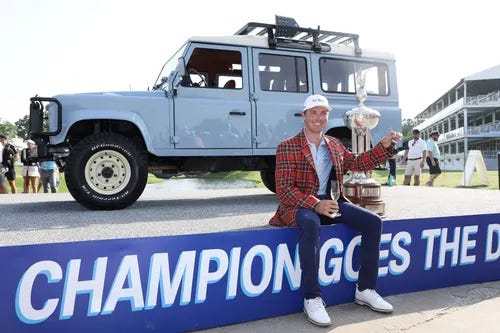
The PGA Tour is staying Texas for one last go-round in the Lone Star State; this time it’s the Charles Schwab Challenge at Colonial Country Club in Fort Worth.
The tournament was known as the Colonial National Invitational from its founding in 1946 until 1989 when sponsors started adding their name to the title. The word ‘colonial’ was dropped from the title altogether when Dean & Deluca took over in 2016. The doomed grocer pulled out of their six-year title sponsorship agreement after two years and the tournament went without a title sponsor in 2018, going by the Fort Worth Invitational instead. Charles Schwab picked up the title sponsorship the following year.
Although many of the greats have competed and won at the Colonial, the tournament is most strongly associated with Ben Hogan, who grew up in Fort Worth and won the tournament five times, including back-to-back wins in 1946 and 1947, back-to-back wins again in 1952 and 1953, and his last professional win in 1959. Mr. Hogan’s ties to the area and success at the course led to it being the second course dubbed ‘Hogan’s Alley’ (the other is Riviera, where he won three times in two years).
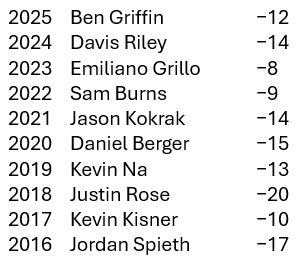
Ben Hogan won the first two events at -1, but in more recent times the winning scores have fallen between -9 and -20. Three years ago, when Emiliano Grillo took home a 1973 Ford Bronco, firm and fast conditions, a little wind, and longer rough than usual kept the winning score to -8 (cutline: +1; median score for cut makers: E). Two years ago, some pre-tournament rain allowed for good scoring and Davis Riley backed up a pair of 66s with a 64 on Saturday to take a four-shot lead into the final round. Then the winds came with gusts up to 30 mph and Davis Riley was able to extend his lead with a round of even par, finishing at -14, five shots ahead of the second-place finisher, and receiving a 1975 Schwab Stinger (cutline: +1; median score for cutmakers: E).
Last year, golfers saw a little bit of everything again. There was some rain early in the week, relatively light winds on Thursday and Friday, and strong winds over the weekend with gusts up to 30 mph. Ben Griffin and Matti Schmid were neck-and-neck for the first three days with identical scores of 66, 63, and 68 to take the lead into the final round. Ben Griffin eagled the first hole on Sunday and birdied the 2nd hole to jump out to a quick lead but then bogeyed four times before reaching the 18th hole. Matti Schmid had a crazy round with five birdies, six bogeys, and a double before reaching 18. For of those of you who don’t want to do the math, Griffin went into the 18th hole with a two-stroke lead over Schmid. Schmid then holed out from off the green for birdie, meaning Griffin would need par to win. Even with the added pressure, Griffin drained his 4-foot par putt to get the win at -12 and take home a 1992 Schwab Defender (a customized Land Rover Defender) (cutline: E; median score for cutmakers: -2)
Here are the last 10 winners and their scores:
The Field
The Charles Schwab Challenge is one of the five tournaments with invitational status on the PGA Tour, though it is the only one that is not a signature event. This provides a few notable exceptions from regular tournaments, including smaller fields, no requirement to fill the field using the PGA Tour Priority Ranking System, no open qualifying and the winner is granted a three-year tour exemption. Organizers have also used the invitational status of the tournament to establish a tradition called the Champion’s Choice invitation, in which past champions vote for two younger golfers to play in the event that wouldn’t otherwise be invited.
As an invitational, the organizers can attract some of the biggest names in golf to the event (though it might also be the official Scottish royal tartan plaid jacket and vintage car the winner receives). Most years, the strength of the field is above the tour average. Last year was no different with a strength of field of 308.7 (19th strongest of 46 tournaments; tour average was 280.1)
The 2025 field is set for 133 golfers, with the usual caveat that it will increase to 135 to accommodate threesomes if Brooks Koepka stays in the field. Unfortunately, it looks like the strength may decrease this year because world #1 golfer Scottie Scheffler has decided to skip the event. There is only one golfer inside the top ten in OWGR, J.J. Spaun. There are 6 other golfers inside the top 25 though, including Ludvig Aberg and Justin Thomas. Nick Dunlap and Mason Howell are this year’s Champions’ Choice invitees.
Course Description

The routing at Colonial Country Club was designed by Perry Maxwell while John Bredemus supervised its construction. It is a classical parkland layout built along the Clear Fork Trinity River near the campus of Texas Christian University. It opened in 1936 and hosted the first CSC in 1946. The 80-year run at the same course is the longest for a non-major on the PGA Tour.
As soon as the final group walked off the green in 2023, Gil Hanse began working on a $20-million renovation of the course. The project took on the dual task of restoring the original feel of the course and bringing it into the modern era. Hydronics systems were installed on all the greens, the green was relocated on the par-3 8th hole, the par-3 13th hole got a makeover, the fairway on the 5th hole was leveled and the trees lining the Trinity River were removed, every green was lowered, and some fairway bunkers were removed and replaced with grass. The course is very much the same course that PGA golfers revere, but it can now be dialed back for amateurs and toughened up for the professionals.
After the renovation, every yardage on the scorecard changed from the previous year. The only hole that saw a notable change, however, is the par-4 7th, which was 40 yards longer. Every other hole only saw marginal changes which were small enough to be the result of changes in tee or hole location.
There has also been an ongoing tree removal project since the renovation. Subtle changes have been made that restored historical sightlines, improved turf health and airflow, and reintroduced strategic angles that had become crowded over decades of tree growth. There is no indication that significant removals have occurred ahead of 2026 edition of the CSC, however.
There is also nothing to suggest any other changes have been made to the course this year, including no changes made to the scorecard.
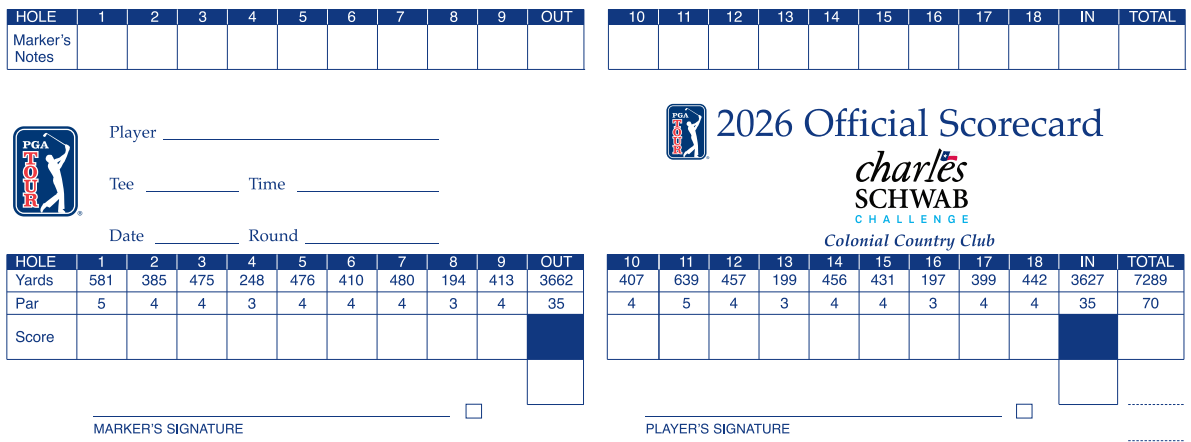
Colonial is now a 7,289-yard, par-70 classical design. By par, it is the 13th longest course on tour this year (out of the 38 courses I did calculations for). It was the 13th most difficult course on tour last year (out of the 40 that are ranked by DataGolf).
There are four par 3s, twelve par 4s, and two par 5s. The course is highlighted by the “Horrible Horseshoe,” a rigorous stretch of holes consisting of the 3rd, 4th, and 5th holes. The opening hole is a welcoming par 5 that is reachable by everybody, but the other par 5 is a 639-yard behemoth. They were the easiest and third easiest holes on the course last year; even the longer par 5 gives up birdies about 24% of the time.
The second and fourth easiest holes on the course were a 385-yard and a 410-yard par 4. Another short par 4, the 387-yard 17th, was the fifth easiest hole on the course. Five of the par 4s are in the 450–500-yard range and five are in the 450–500-yard range.
Three of the par 3s play a hair under 200 yards, and the fourth is a monstrous 247 yards; none of them average under par.
Here is the official 2026 scorecard:
Off the tee, golfers will see tight, tree-lined fairways (29.9 yards wide, 14th narrowest fairways last year, according to DataGolf). Over-hanging trees create narrow chutes (though that has been mitigated somewhat by the tree removal program), crowd the fairways, and can block approach shots, meaning golfers must be precise off the tee to avoid tree trouble and get the best angle into the greens on the approach. The Bermuda grass rough is about average in length (2.5 inches) and can be difficult to play from. The fairways are Tifway 419 Bermuda grass. There are bunkers in the landing areas (there is a total of 64 bunkers throughout the course), and water is in play on six holes. The difference between the highest and lowest points is only 8 m, but Bredemus and Maxwell made use of the natural topography to create some movement in the fairways. There are also doglegs in both directions to test the shot-shaping ability of the golfers, though some touts will say that the course favors a fade.
On approach, golfers will see small, bent grass greens (5,000 sq. ft.). They usually play a little firm and fast (stimp = 12.5). They are protected by numerous bunkers, false fronts, and water on a few holes. The putting surfaces have a subtle undulation that takes some experience to fully understand. Most of the green fronts are open, so run up shots are possible.
Hitting the fairways is a big key to success at Colonial; according to DataGolf, it had the 16th highest penalty for playing from the rough on tour last year, but that is down from previous editions. Controlling distance and spin is important when playing into small greens that are firm and fast, and that’s nearly impossible when playing from Bermuda rough. Unfortunately, the fairways are among the more difficult fairways to hit on tour (Driving Accuracy was 54.1%; 9th most difficult of 40 courses on DataGolf).
An interesting thing has happened since the renovation though; driver usage has actually gone up. Prior to the renovation, driver usage was below 60%. Two years ago, it jumped up to 65%, and last year it 69%, right at the tour average. One way to think about it is that driver has become the preferred club on two additional holes; the par 4 7th is a good candidate because it was lengthened by 40 yards. Another possibility is that the removal of bunkers and trees has led to golfers feeling more comfortable being aggressive off the tee.
Average Driving Distance has also increased. Prior to the renovation it was in the low 280s. In 2024 it jumped to 289.9 yards, and last year it was 294.8 yards (20th of 40 courses). The Course Insights page on DataGolf shows that the course still favored accuracy in 2024 but was neutral in 2025.
The difficulty hitting fairways, and the associated penalty, is also reflected in the number of greens hit in regulation (Green in Regulation is 59.1%; 10th most difficult of 40 courses). Colonial was the 12th most difficult course on approach last year overall, and it was the third most difficult from inside 150 yards.
Golfers at least seem to get a reprieve around the greens. Around the green play was the 35th most difficult last year and the Scrambling Percentage was 62.1% (tour average is 58.9).
The Weather
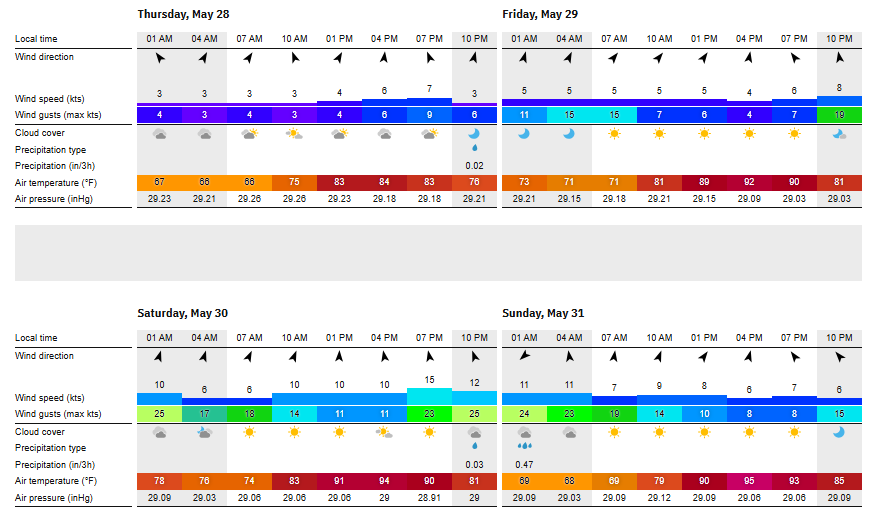
Like most courses in Texas, the wind can play a significant role with how hard Colonial plays. Two years ago, winds hit 30 mph on the weekend, and the winning score was -8. In 2018, when the wind was calm, the winning score was -20. Rain can also play a role by softening the course, and dampening the impacts of the wind, or creating good scoring conditions if the winds are down.
As of now, there is heavy rain in the forecast on Wednesday and light winds on Thursday and Friday, so scoring should be good for the first two rounds. The winds pick up to 10-15 mph with a chance of gusting on Saturday. There is more rain in the forecast on Saturday night with winds starting with 20 mph gusts that subside throughout the day. It’s going to be hot too with highs in the 90s.
DFS Strategy
As always, the first thing to do is come up with our plan for the week, including bankroll usage, contest selection, leverage, and roster construction. I’ll then go over the type of golfers that I am targeting and the models I’ll use to find those golfers.
The list of winners is rather unremarkable, but it’s also not full of long shots either. Jordan Spieth is on the list from an era when he was one of the best golfers on the planet, but most of the other winners are middle-of-the-odds-board type of guys. Jason Kokrak and Sam Burns were 9k golfers, Ben Griffin was in the 8ks, and Emiliano Grillo was in the high 7ks (Davis Riley is an exception in the 5ks). These guys are also predominately ballstrikers; they keep the ball in play off the tee and perform well with their irons. I would say this metric actual points to a good amount of predictability, even though it’s not the best golfers that can be relied upon to win.
The number of Penalty Strokes and Reloads at the course, according to DataGolf, is usually towards the low end of the tour. Last year, it had the fifth fewest Reloads. This points towards low volatility, meaning it’s fairly difficult to play yourself out of the tournament with a single bad hole.
The Chalk Report has been a bit of a mixed bag. There always seem to be some notable examples of the chalk busting at this tournament; a tough golf course is capable of taking out some of the best golfers. Other chalk has performed reasonably well at Colonial though. I would say this metric is neutral. We can rely on some of the chalk playing well, but there will be some surprises as well; we’ll just have to build our player pools accordingly.
The Course Insights on DataGolf regarding whether the tournament favors Accuracy or Distance goes back to 2004. In just three of those years the course favored bombers. It was neutral in five years, and favored accuracy in 14 years. Even in the past two years, when golfers have been pulling driver more, the course has favored accuracy or been neutral. I think we can reasonably conclude that this course favors accuracy over distance most of the time, which puts it in the predictable column because we know which types of golfers we can reliably target.
The slope of the DataGolf Strokes Gained: Total vs. Predicted regression for Colonial has been under one for nine of the last ten years. That means that higher-skilled players have a more difficult time separating themselves from lower-skilled players than they do at a typical PGA Tour course. This defies are expectations; the best golfers are generally able to separate themselves at the more difficult courses. I think this might be the case because distance isn’t a big factor; as long as golfers keep their ball in the fairway, they will usually have a scoring club in their hands on approach. This opens things up for anybody hitting the ball well. This does, however, make the tournament less predictable because anybody can compete, not just the top players.
Overall, I think these metrics points towards the Charles Schwab Challenge at Colonial Country Club having a slight lean towards being a stable, predictable event. The best golfers in the world may not be able to separate themselves, but it appears the best ballstrikers, regardless of overall skill, can separate themselves. I, therefore, am comfortable playing my usual bankroll this week.
Even though this event isn’t a major or signature event, DraftKings should still run its full slate of contests; double-ups, 50/50s, single-entry contests, GPPs, and the Fantasy Golf World Championships and Millionaire qualifiers. If you liked the contests you’ve been playing, they should be available again this. Less noteworthy events, like the Charles Schwab, usually have smaller contests, and smaller prizes, though. Be sure to check the contest sizes early in the week to make sure you’re still interested in them or need to arrange other plans. I think GPPs are in play this week, but since this course can be on the more predictable side, 50/50s and double ups are also a viable option. The 50/50s and double ups don’t offer the same disproportionate prizes to the winner, but they do payout more players. The upside is lower, but the floor is higher.
Once you have decided which contests you will be playing in, we need to decide how much leverage we want and how we’re going to get that leverage.
While the top talent in the field at the Charles Schwab has had difficulty separating themselves, Scottie Scheffler has been immune to this trend. This led to cumulative ownerships of winning lineups at or above 80% in 2023 and 2024 because Scottie was over 40% owned. Last year, Scottie finished T4 but did not appear in the winning lineup of the Birdie, and the cumulative ownership of the winning lineup was 47.5%. That’s probably a little extreme because Scottie was soaking up so much ownership. This year, with Scottie not in the tournament, I think we’ll still want to aim towards lower cumulative ownerships but 60-70% should probably suffice. That’s at the low end of the range I recommend, so we’ll want to get a little more leverage than usual.
As always, we have the same three places we turn to for leverage every week. The first is the ownership projections, where we will try to identify the chalk and then look for good pivots off the chalk. We can also us the projected ownership to figure out what the popular roster constructions are going to be and then figure which constructions will lead to unique combinations of golfers. We can then look at the pricing; identify golfers that are priced too low and consider fading them because they will likely be over-owned and identify the golfers that are priced too high and give them consideration because the DFS community will try to avoid them.
I think DFS players will be targeting the plodders (short but accurate) with strong course histories. We can differentiate ourselves by targeting some bombers. They’ll probably go overlooked, but if they’re able to dial it back when needed, their distance could give them an advantage on the par 5s and on the cuttable doglegs. This could also give us an edge because other DFS players may not have noticed that golfers are using their drivers more at Colonial over the last two years.
We can also target golfers with little or no course history. Experience at the course will certainly help, but Justin Rose won the event on his first trip to Colonial, so it’s not imperative. The young guns on tour are always demonstrating that they don’t necessarily need to have seen a course to be successful at it as well.
I also have in my notes that the winners tend to be over the age of 30 (a trend that Kenny Kim dug up). This could be a narrative that DFS players grab onto. This trend has fallen apart, though, since Jason Kokrak won at Colonial. The prime age now appears to be the late 20s. If this narrative is still being pushed, we should be able to get some leverage by targeting younger golfers.
We usually look towards roster construction for leverage, but it looks like Ludvig Aberg and Justin Thomas will be the top names in the 10k range, and I just don’t know how much appetite there will be to play them. Certainly not overwhelming chalk like Scottie Scheffler. I guess for now I would lean towards stars and scrubs being the popular lineup build, and we should be able to get leverage with super stars-and-scrubs and balanced lineups. We should look at the ownerships projections first before using a specific lineup construction for leverage though.
Once you’ve decided which contests you want to play and how you’re going to get leverage, you can start thinking about roster construction. So, turning to the Roster Construction Matrix, we have a mid-level field on a difficult course. The matrix points us towards a stars-and-scrubs build. Stars-and-scrubs lineups have been successful at Colonial, even when Scottie Scheffler was not in the winning lineup. My early preference is for stars-and-scrubs lineups, but if you’re not comfortable with the stars in this field, balanced lineups may be the way to go, especially if they’ll be able to get you some leverage.
My plan this week is to stick to my usual bankroll and play a mix of GPPs and cash games. I will still enter one of the 20-entry contests, but I will also include some 50/50s and double ups. I will likely build an even split of stars-and-scrubs lineups (led by Ludvig Aberg) and balanced lineups, though that could change if I decide that I really like one of the other 10k options. I’ll play the chalk that I like and mix in a few low-owned pivots and golfers with less than 5% ownership and try to keep my projected cumulative ownerships between 60% and 70%. Since I am going out a little on the risk curve to get leverage, I will likely have 3-5 one-offs.
Now that we have a plan for the week, we can focus on the type of golfers we will target.
Colonial is a strategic challenge that favors precision over brute strength. It’s a positional course that can’t simply be overpowered, meaning every type of golfer has a chance to be in the mix on Sunday. Off the tee, accuracy is rewarded over distance; golfers need to be in the fairway with good angles into the greens. On approach, golfers need to be precise with their irons to keep the ball on the small greens that tend to run firm and fast. Once on the green, elite putting on bent grass is needed to distinguish yourself from the other contenders. It’s not a course where a ton of birdies will be needed to win, instead golfers need to avoid costly mistakes on holes where par is a good score.
The list of winners demonstrates that any type of golfer can get it done around Colonial. Short-game specialists like Kevin Na and Kevin Kisner have won here. Ballstrikers like Emiliano Grillo, Justin Rose and Daniel Berger have also won. And even long hitters like Sam Burns and Scottie Scheffler can contend if they can throttle their game down to suit the course.
Whether they are long or short off the tee, golfers find success by keeping the ball in the fairways, giving themselves a good angle into the greens, and being exact with their irons. But they have also been able to find success by being tidy around the greens and getting hot with the putter.
As usual, I will start my process by building my Course Fit model and putting together the Recent Form and Course History spreadsheet. I will use my model to target golfers that are that are accurate off the tee, are strong with their short and mid-irons, are comfortable putting on bent grass, and avoid costly mistakes.
Experience at Colonial is important. While substantial changes have been made to the course somewhat recently, I think the overall feel is the same. Golfers need an understanding of when to play conservatively off the tee, the subtleties of the greens, and the nuances of the wind. We have plenty of Course History to work with, however. The tournament has been played on the same course since 1946, and except for 2020 when it was played in June without spectators due to the Covid-19 pandemic, the tournament has always been played in May.
The Predictive model takes a little more time to put together. In the interest of getting the spreadsheet out early so you can start your research, I will omit the Predictive model rankings from the first draft of the spreadsheet but will include both rankings in the deluxe version.
Here are the course fit statistics that I will be using (all from the last 100 rounds):
Off-the-tee:
Driving Accuracy: I really want to emphasize accuracy this week and will use this statistic to tilt my model in favor of the golfers who hit the most fairways. Golfers playing from the fairway will have a much easier time avoiding bogeys and could even give themselves looks at birdies. I will look at this statistic on long courses.
Strokes Gained: Off the Tee: While I still want to emphasize accuracy this week, there is evidence that the tournament is shifting towards more driver usage and distance off the tee. I want to target complete drivers of the golf ball, golfers that keep the ball in the fairway but can also ramp up the fire power when needed. I will look at this statistic on long course.
Approach:
Strokes Gained: Approach: A staple in my model week after week; precision on the approach is needed to contend at Colonial, so it will maintain its spot as the most heavily weighted statistic in my model. I will look at this statistic on long courses.
Proximity 125-175: Approximately 45% of approach shots will come from this range, I want to roster the best golfers from these distances.
Around-the-Green:
Scrambling on bent grass: With tough to hit fairways, small greens, and possibly windy conditions, hitting greens will be difficult. The scrambling percentage is right at the tour average, so scrambling shouldn’t be too difficult, but golfers that are adept around the green should be able to separate themselves.
Putting:
Strokes Gained: Putting: Putting is another staple in my model; I will switch up the surface as needed. This week, we’re looking for bent grass specialists.
Scoring:
Strokes Gained: Total on Difficult Courses: Some golfers perform well at the birdie fests, while other golfers perform well when they have to grind out pars. This week, we’re looking for the latter.
Bogey Avoidance: With just a handful of scoring opportunities on the course, and golfers mainly grinding out pars, golfers will need to avoid giving any strokes back to the field if they want to stay in contention.
Par 4 Efficiency: As a par 70, twelve of the holes on the course par 4s. Golfers don’t necessarily need to score on these holes, but they better be making pars.
Some of the other statistics that I am interested in and will include on the spreadsheet but not in the Course Fit model are:
Par 5 Birdie or Better %: With just two par 5s on the course, I’m not going to include par 5 statistics in my model, but I do want to make sure anybody I roster is capable of making birdies on them.
Strokes Gained: Par 4 350-400 yards: With only two par 5s on the course, golfers must find other places to manufacture scoring opportunities. The two short par 4s are two of the best options on the course.
Strokes Gained: Par 3 175-200 yards: The par 3s are long and difficult. I want to make sure that I am rostering golfers that won’t be giving too much back when they play them.
Strokes Gained: Total in Texas: Some golfers just seem to enjoy playing in Texas. I want to be sure to give those guys some consideration this week.
Strokes Gained: Total in the Wind: Wind can always be an issue in Texas. If it looks like the wind is going to be up, I want to target golfers that are comfortable in the wind.
In short, I am looking for golfers that are accurate off the tee, strong with their short and mid irons, comfortable putting on bent grass greens, and play well on difficult courses. The Course Fit statistics that I will be focusing on Driving Accuracy, Strokes Gained: Approach, Proximity 125-175 yards, Strokes Gained: Putting on Bent, and Strokes Gained: Total on Difficult Course.
The statistics that will go into my Predictive model are:
Strokes Gained: Approach
Strokes Gained: Tee to Green
Driving Accuracy
Proximity 125-175
Par 4 Efficiency
That’s all I have for now, be sure to follow me on Twitter (@glzisk) for any updates.