
The Fringe
PGA DFS preview: Charles Schwab Challenge and Colonial Country Club

Happy PGA Championship Sunday!
I can’t say that this is going to be one for the ages, but it is going to be really good. The favorites have faltered somewhat, but there is a litany of exciting and consequential names at the top of the leaderboard. I hope you’ve cleared your schedule because this should be some compelling TV.
Let us know in the comments if you have a good sweat going.
The Past
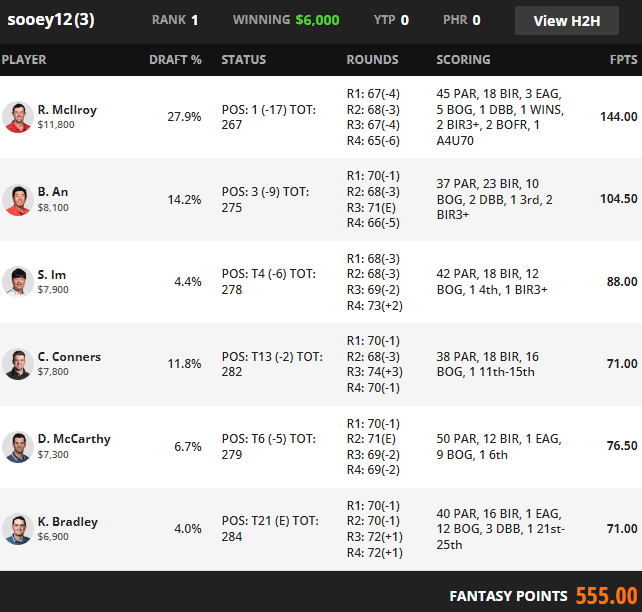
Congratulations go to sooey12 for winning the $70k Birdie for the Wells Fargo.
Sooey12 was able to get the job done using just three of a possible 20 lineups. Their next best finish was 2299th (top 7,209 got paid). The first-place finish was worth $6,000, but they didn’t add much more than that.
The winning lineup of this contest usually has the winner of tournament, but with 39.5 more points than the closest competitor, it was critical to have rostered Rory McIlroy to have any chance of winning this week. Sooey12 backed up the champion with another three golfers inside the top ten, a T13 and a T21.
Their margin of victory was 5.5 points.
The lineup was an alternative take on the standard stars-and-scrubs build. With Rory McIlroy priced at $11,8000 and no $5K range, the standard build wasn’t going to work anyway. Instead, Sooey12 rostered one 10k+ golfer (Rory), one in the 8ks, three in the 7ks and one in the 6k range.
There was almost no overlap in their player pool. With just three lineups, they still had 16 golfers in their player pool. They rostered Rory McIlroy and Max Homa twice, but every other golfer in their pool was a one-off.
McIlroy was the only 10k+ golfer in their player pool. They also had two from the 9ks, four from the 8ks, six from the 7ks, and three from the 6ks. It’s a fairly typical distribution for pools this size.
Cumulative ownership for the winning lineup was 69%, right in the middle of the range we typically shoot for (60-80%). Overall, they had a good balance of chalk and low-owned plays. They used three golfers above 20%, one golfer from the 15-20% range, seven from the 10-15% range, two golfers from the 5-10% range, and three golfers that were under 5%, including one golfer under 1%.
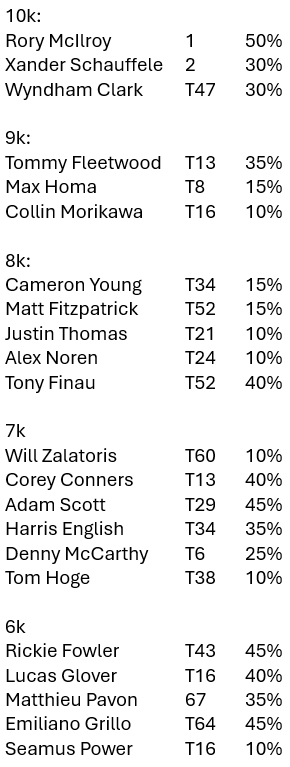
It was an acceptable week for me in the Birdie. I knew that playing the three highest-priced golfers in the field would require a little more dumpster diving than usual and, thankfully, a couple of the picks worked out (that’s my player pool above). With Rory and Xander dueling up top (for 63 holes at least), and a few low-priced golfers coming through, I had eight lineups comfortably cash. I didn’t have all the pieces put together, so none of them made a run up the board, but they did well enough to get most of my money back. Thankfully, my single-entry lineup also cashed and won a 10-person contest put together by @ScottSt1963 (they are open to anybody, and I usually post a link to the contest on X if you’d like to play against me and some of my friends). Not a huge win, but my first profitable week in over a month or so.
The Wells Fargo was a no-cut event this year, so no analysis of my 6/6 lineups versus the field.
My One-and-Done selection was Xander Schauffele, who finished in 2nd place. Unfortunately, I had already used him at the Farmers and the RunGoodGolf website doesn’t have anything in place to keep you from selecting the same golfer twice. So, despite the good pick, I fell in the rankings.
Click on the underlined text for the full story.
Scottie Scheffler’s wife Meredith gave birth to their first child last week. Scheffler shot two-over par on Saturday at Valhalla, breaking a streak of 42 consecutive rounds under par, so maybe it takes a some time for the baby swag to take effect.
Heading the other direction, Rory McIlroy filed for divorce from his wife just prior to the PGA Championship. It has been a good, not great, week for Rory, so maybe the bachelor swag takes some to take effect too.
In other Rory news, Butch Harmon revealed that he work with Rory on changing his approach to shots from 150 yards and in. Just having won two tournaments in a row, it appears to have worked.
The new Titleist 2-wood prototype has been popular among professional golfers with Max Homa the latest to add it to his bag. Shane Lowry put a new putter in his bag for the Zurich, and the switch has certainly paid off.
Having struggled through much of the early part of the season after winning the FedEx Cup last, Viktor Hovland has gone back to his old swing coach, Joe Mayo ahead of the PGA Championship. He’s in contention heading into the final round, Mayo might just be what he needs to turn things around.
The Present
The PGA Tour is Louisville, Kentucky for the PGA Championship at Valhalla Golf Club. Xander Schauffele and Collin Morikawa are tied for the lead at -15 heading into the final round. Sahith Theegala is one stroke back and Shane Lowry, Bryson DeChambeau, and Viktor Hovland are two off the lead.
I thought the AM/PM wave might have a small advantage, but my conviction wasn’t strong enough to recommend any wave stacking. It actually ended up with a much bigger advantage than I expected.
Here is the complete breakdown from @RobBoltonGolf:
Round 1 average: AM: 71.33; PM: 71.22
Round 2 average: AM: 71.77; PM: 70.31
AM/PM total: 141.64
PM/AM total: 142.99
Advantage: PM/AM by 1.35 strokes
Taylor Montgomery and Steve Stricker withdrew prior to the tournament. John Daly (thumb) withdrew after the first round. K.H. Lee and Ben Griffin withdrew prior to the second round resuming on Saturday.
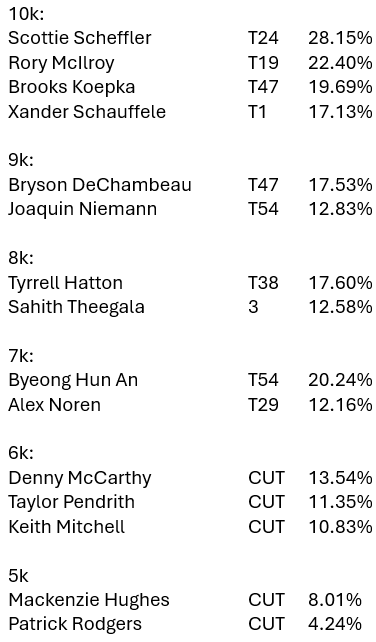
Here is how the chalk is performing after three rounds (% from $125K Birdie):
ESPN will have final round coverage from 10:00 a.m. to 1:00 p.m. ET, and CBS will pick it up from there. The stream on ESPN+ started at 8:00 a.m. ET.
The Future
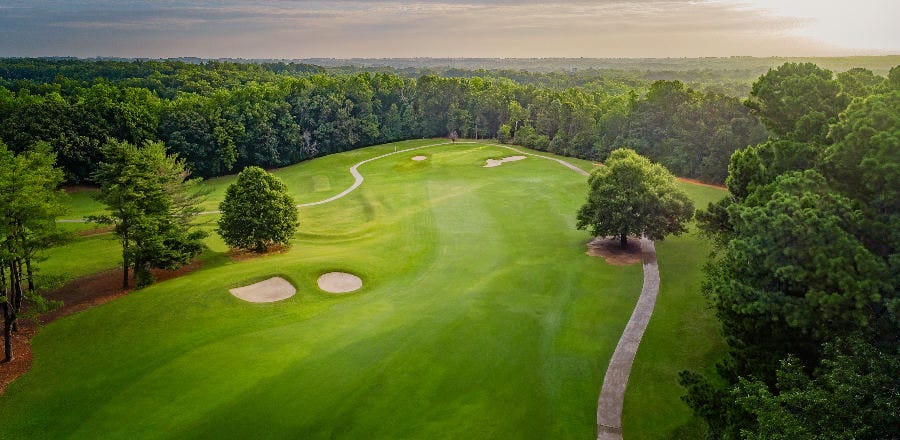
The PGA Tour is heading back to Texas for one last visit, this time for the Charles Schwab Challenge at Colonial Country Club in Fort Worth.
The tournament was known as the Colonial National Invitational from its founding in 1946 until 1989 when sponsors started adding their name to the title. The word ‘colonial’ was dropped from the title altogether when Dean & Deluca took over in 2016 (Dean & Deluca filed for bankruptcy in 2019, while the Colonial is still strong). The doomed grocer pulled out of their six-year title sponsorship agreement after two years. The tournament went without a title sponsor in 2018, going by the Fort Worth Invitational instead. Charles Schwab picked up the title sponsorship the following year.
Although many of the greats have competed and won at the Colonial, the tournament is most strongly associated with Ben Hogan, who grew up in Fort Worth and won the tournament five times, including back-to-back wins in 1946 and 1947, back-to-back wins again in 1952 and 1953, and his last professional win in 1959. Mr. Hogan’s ties to the area and success at the course led to it being the second course dubbed ‘Hogan’s Alley’ (the other is Riviera, where he won three times in two years).
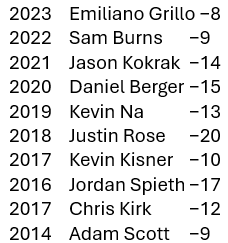
Ben Hogan won the first two events at -1, but in more recent times the winning scores have fallen between -9 and -20. Last year, firm and fast conditions, a little wind, and longer rough than usual kept the winning score to eight under par (cutline: +1; median score for cut makers: E). It might have been -10, but Emiliano Grillo put his tee shot into a canal on the 18th hole, dropping two shots and falling back into a tie with Adam Schenk and Harry Hall who were in the group behind him. Harry Hall also put his ball into the water on the 18th hole and bogeyed the hole while Adam Schenk made par to force a playoff with Grillo. Emiliano bounced back with a birdie on the second playoff hole to win the tournament and claim the 1973 Ford Bronco.
Here are the last 10 winners and their scores:
The Field
The Charles Schwab Challenge is one of the handful of tournaments with invitational status on the PGA Tour. This provides a few notable exceptions from regular tournaments, including smaller fields, no requirement to fill the field using the PGA Tour Priority Ranking System, no open qualifying and the winner is granted a three-year tour exemption. Organizers have also used the invitational status of the tournament to establish a tradition called the Champion’s Choice invitation, in which past champions vote for two younger golfers to play in the event that wouldn’t otherwise be invited.
As an invitational, the organizers can attract some of the biggest names in golf to the event (though it might also be the official Scottish royal tartan plaid jacket and vintage car the winner receives). Most years, last year included, the strength of the field is above the tour average (276; 17th strongest of 43 tournaments; average was 268). Even though it’s not a designated event, it appears the CSC will have another good showing this year with world #1 Scottie Scheffler, Viktor Hovland, Max Homa, Brian Harman, and Collin Morikawa all signed up to play. This year’s Champion’s Choice invitations are going to Max Greyserman and Parker Coody.
The field is set for 133 golfers; nobody else is getting in unless somebody withdraws.
Course Description
John Bredemus and Perry Maxwell designed Colonial Country Club. It is a classical parkland layout built along the Clear Fork Trinity River near the campus of Texas Christian University. It opened in 1936, and first hosted the first CSC in 1946. The 78-year run at the same course is the longest for a non-major on the PGA Tour.
As soon as Emiliano made his winning putt last year, Gil Hanse began working on a $20-million renovation of the course. The project took on the dual task of restoring the original feel of the course and bringing it into the modern era. Hydronics systems were installed on all the greens, the green was relocated on the par-3 8th hole, the par-3 13th hole got a makeover, the fairway on the 5th hole was leveled and the trees lining the Trinity River were removed, every green was lowered, and some fairway bunkers were removed and replaced with grass. The course is very much the same course that PGA golfers revere, but it can now be dialed back for amateurs, and toughened up for the professionals.
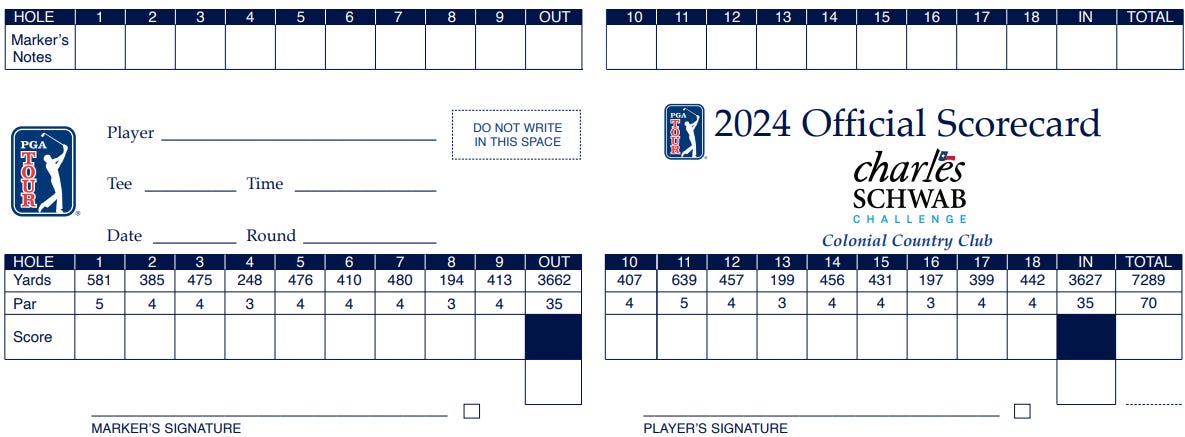
Every yardage on the scorecard has changed this year. The only hole that saw a notable change, however, is the par-4 7th, which is now 40 yards longer. Every other hole only saw marginal changes which were small enough to be the result of changes in tee or hole location.
It is now a 7,289-yard, par-70 classical design. There are four par 3s, twelve par 4s, and two par 5s. Last year it was the 9th most difficult course on tour (out of 49) highlighted by the “Horrible Horseshoe,” a rigorous stretch of holes consisting of the 3rd, 4th, and 5th holes. By par, it is the 13th longest course on tour.
The opening hole is a welcoming par 5 that is reachable by everybody, but the other par 5 is a 639-yard behemoth. They were the easiest and third easiest holes on the course last year; even the longer par 5 gives up birdies about 25% of the time. Although they are among the best scoring opportunities on the course, they are the third most-difficult set of par 5s on tour, according to DataGolf.
The second and fourth easiest holes on the course were a 389-yard and a 406-yard par 4. Another short par 4, the 387-yard 17th, was the fifth easiest hole on the course. Five of the par 4s are in the 450–500-yard range and five are in the 450–500-yard range.
Three of the par 3s play a hair under 200 yards, and the fourth is a monstrous 247 yards; none of them average under par.
There were no holes at Colonial that appeared on the list of the 50 toughest holes on tour.
Here is the official 2024 scorecard:
Off the tee, golfers will see tight, tree-lined fairways (27 yards wide at 300 yards; 11th narrowest of 30 measured courses). Over-hanging trees create narrow chutes, crowd the fairways, and can block approach shots, meaning golfers must be precise off the tee to avoid tree trouble and get the best angle into the greens on the approach. The Bermudagrass rough is above average in length (3 inches) and can be difficult to play from. The fairways are Tifway 419 Bermudagrass. There are bunkers in the landing areas (though fewer than there were before) and water is in play on six holes. The difference between the highest and lowest points is only 8 m, but Bredemus and Maxwell made use of the natural topography to create some movement in the fairways. There are also numerous doglegs, in both directions, to test the shot-shaping ability of the golfers, though some touts will say that the course favors a fade.
On approach, golfers will see small, bentgrass greens (5,000 sq. ft.). They usually play a little firm and fast (stimp = 12.5). They are protected by numerous bunkers, false fronts, and water on a few holes. The putting surfaces have a subtle undulation that takes some experience to fully understand. Most of the green fronts are open, so run up shots are possible.
Hitting the fairways is a big key to success at Colonial; according to DataGolf, it has fifth highest penalty for playing from the rough on tour (though it was the fourth easiest when playing from a non-rough area off the fairway). Unfortunately, the fairways are among the more difficult fairways to hit on tour (Driving Accuracy was 57%; 32nd of 47; average was 62.1%). The Driving Accuracy numbers are likely inflated a little too because golfers will club down to make sure they get properly positioned in the fairway (average Driving Distance was 278.5 yards; 26th of 35; average was 285.1). The difficulty hitting fairways, and the associated penalty, is also reflected in the number of greens hit in regulation (Green in Regulation is 64.2%; 28th of 47; average was 66.2%). With golfers clubbing down off the tee and the difficulty in hitting fairways and playing from the rough, Colonial has been the fourth most difficult course to gain strokes off the tee.
Golfers at least seem to get a reprieve around the greens. Scrambling difficulty was slightly below average (Scrambling percentage was 59.2%, tied for 20th of 47; average was 58.5%) and it’s the fourth easiest course to gain strokes from the bunkers around the green.
The weather
Like most courses in Texas, the wind can play a significant role with how hard Colonial plays. Two years ago, winds hit 30 mph on the weekend and the winning score was -8. Last year, and in 2014, there was a moderate wind during the entirety of the tournament and the winning score was also -9. In 2018, when the wind was calm, the winning score was -20. As of now, the forecast is calling for 10-15 mph sustained winds with 20 mph gusts on Thursday, Friday, and Saturday. They then could jump up to 20 mph with 30 mph gusts for Sunday. There could also be rain on Wednesday and Thursday, so the course may start out a little soft. Highs in the 80s with mostly cloudy skies.
DFS Strategy
Colonial is a strategic challenge that favors precision over brute strength. It’s a positional course that can’t simply be overpowered, meaning every type of golfer has a chance to be in the mix on Sunday.
The list of winners demonstrates that any type of golfer can get it done around Colonial. Short-game specialists like Kevin Na and Kevin Kisner have won here. Ballstrikers like Emiliano Grillo, Justin Rose and Daniel Berger have also won. And even long hitters like Sam Burns and Scottie Scheffler can contend if they can throttle their game down to suit the course.
Whether they are long or short off the tee, golfers find success by keeping the ball in the fairways, giving themselves a good angle into the greens, and being exact with their irons. But they have also been able to find success by being tidy around the greens and getting hot with the putter.
As usual, I will start my process by building my course fit model and putting together Recent Form and Course History spreadsheets. I will use my model to target golfers that are accurate off the tee or can at least hit the green when they miss the fairway, are strong with their mid-irons, can keep it clean around the greens, and are comfortable putting on bentgrass.
Experience at Colonial is important. While substantial changes were made to the course, I think the overall feel is the same. Golfers need an understanding of when to play conservatively off the tee, the subtleties of the greens, and the nuances of the wind. We have plenty of course history to work with, however. The tournament has been played on the same course since 1946, and except for 2020 when it was played in June without spectators due to the Covid-19 pandemic, the tournament has always been played in May.
Here is the top ten in Course History from my One-and-Done tool:
1. Jordan Spieth
2. Tony Finau
2. Sam Burns
4. Collin Morikawa
5. Daniel Berger
6. Viktor Hovland
7. Harry Hall
7. Scottie Scheffler
9. Paul Haley II
10. Xander Schauffele
10. Max Homa
Here are the course fit statistics that I will use (last 100 rounds):
Off-the-tee:
Good Drives Gained: Colonial is a course that rewards accuracy over distance; golfers must play their tee shot to the correct position to have good line to the green, ideally from the fairway so they can control the spin on the small greens. In the likely event that they do miss the fairways, they need to be able to hit the green from rough. I will look at this statistic on course 7,200 to 7,400 yards in length.
Fairways Gained: I really want to emphasize accuracy this week and will use this statistic to tilt my model in favor of the golfers who hit the most fairways. I will look at this statistic on course 7,200 to 7,400 yards in length.
Approach:
Strokes Gained: Approach: A staple in my model week after week; precision on the approach is needed to contend at Colonial, so it will maintain its spot as the most heavily weighted statistic in my model. I will look at this statistic on course 7,200 to 7,400 yards in length.
Greens in Regulation: On a course with tight fairways, small greens, and potentially windy conditions, it’s going to be important to target golfers that hit a lot of greens and give themselves stress-free pars. I will look at this statistic on course 7,200 to 7,400 yards in length.
Proximity 125-175: Approximately 45% of approach shots will come from this range, I want to roster the best golfers from these distances.
Around-the-green:
Scrambling on bentgrass: With tough to hit fairways, small greens, and possibly windy conditions, hitting greens will be difficult. The scrambling percentage is right at the tour average, so scrambling shouldn’t be too difficult, but golfers could find themselves scrambling to save par on multiple occasions. I want to roster golfers that get up-and-down consistently.
Putting:
Strokes Gained: Putting: Putting is another staple in my model, I will switch up the surface as needed. This week, we’re looking for bentgrass specialists.
Scoring:
Strokes Gained: Total on Difficult Courses: Some golfers perform well at the birdie fests, while other golfers perform well when they have to grind out pars. This week, we’re looking for the latter.
Strokes Gained: Par 4 350-400 yards: With only two par 5s on the course, golfers must find other places to manufacture scoring opportunities. The two short par 4s are two of the best options on the course.
Strokes Gained: Par 3: The par 3s are long and difficult. I want to make sure that I am rostering golfers that won’t be giving too much back when they play them.
After building my model, I usually have a few other things that I will look at during the Sniff Test to help make my determinations. This week I will look at Birdies or Better/Bogey Avoidance, Sand Saves, Par 5 Scoring, and Strokes Gained: Total in windy conditions.
As of now, it looks like there will be some wind throughout the tournament, and the winning scoring will likely be towards the higher end of the range we have seen. I’ll look at Bogey Avoidance to make sure that I’m rostering golfers that will not struggle in the tough conditions. If the forecast changes, I will switch to looking at Birdies or Better.
When I watched the flyover of the course, one impression I had was that, even though the fronts are open, most of the greens are surrounded by bunkers otherwise. Bunker play will be important to stay in contention, especially if the wind gets going.
There are only two par 5s on the course, but I will give preference to golfers that have demonstrated they can take advantage of them.
Unless the forecast changes, it looks like there’s a rather good chance that it will be blowing, at least, moderately hard this week, I want to roster golfers that are proficient in the wind.
I will also build a model that includes statistics that are only available using The Rabbit Hole on Betsperts.com. This model will include Good Drive % on courses with Difficult Fairways, Strokes Gained: Approach on courses with High Missed Fairway Penalty, Strokes Gained: Around-the-Green on courses with Average ARG Gained, Strokes Gained: Putting on bentgrass, Strokes Gained: Total on Less-Than-Driver-Courses, and Strokes Gained: Total in Texas. Keep in mind that I am still trying to wrap my head around all of the filters available in The Rabbit Hole, and these statistics may change.
Turning to the Roster Construction Matrix, we have a mid-level field on a difficult course. The matrix points us towards a stars-and-scrubs build. My first impression of the stars suggests that this is the way to go. First of all, Scottie looks like he can’t be stopped. Secondly, Collin Morikawa and Viktor Hovland have had success here and look to be rounding into form. Unless the scrubs are really bad, I can’t imagine going another way.
As always, we should be on the lookout for ways to get leverage on our opponents. We will start in the same two places we start our search for leverage every week, then move onto to other ways to get leverage specific to this tournament. The first is the ownership projections, where we will try to identify the chalk, and then look for good pivots off the chalk. The next place we should look is in the pricing; identify golfers that are priced too low and consider fading them because they will likely be over-owned and identify the golfers that are priced too high and give them consideration because the DFS community will try to avoid them.
I think DFS players will be targeting the plodders (short but accurate) with strong course histories. We can differentiate ourselves by targeting the bombers. They’ll probably go overlooked, but if they’re able to dial it back when needed, their distance could give them an advantage on the par 5s and on the cuttable doglegs.
We can also target golfers with little or no course history. Experience at the course will certainly help, but the young guns on tour have demonstrated that they don’t necessarily need to have seen a course to be successful at it (Justin Rose won the event on his first to Colonial).
I also think that the majority of DFS players will be going with stars-and-scrubs lineups. Any super stars-and-scrubs or balanced lineups will most likely be unique builds.
I have in my notes that the winners tend to be over the age of 30 (a trend that Kenny Kim dug up). This could be a narrative that DFS players grab onto. Again, we may be able to get some leverage by targeting less experienced golfers.
There is usually a talk about a hangover after a major, and questions about whether or not the golfers playing Valhalla this week will be able to contend at Colonial (though it may be somewhat muted given how easy Valhalla has been playing). This will likely lead to some of those golfers being under-owned.
Finally, I will be playing 100% of my weekly bankroll for this tournament. We are in the heart of the season and have plenty of Course History data to work with, so I’m comfortable pushing all the chips in.
That’s all I have for now, be sure to follow me on Twitter (@glzisk) for any updates.
Have a great week!