
The Fringe
PGA DFS preview: RBC Canadian Open and TPC Toronto at Osprey Valley (North Course)

Good morning, Fringe readers!
My kids are done with school, which means the summer travel season is upon us. Unfortunately, the timing of some of my travel is simply awful with respect to PGA DFS and the first blunder comes this week.
My travel arrangements are such that there is no way I will be able to get all the research I’ll need to do for the U.S. Open in time to get the Sunday preview out. So, there will be no Fringe next Sunday, but I will still be able to put out the spreadsheets as usual.
I may miss other Sundays over the course of the summer, but I’ll always make the spreadsheets available (I think the U.S. Open is the only event that I will not be playing PGA DFS).
If you’re looking for good free content, Nik at Kahl’s Call on YouTube will still be doing his thing with three shows previewing the tournament.
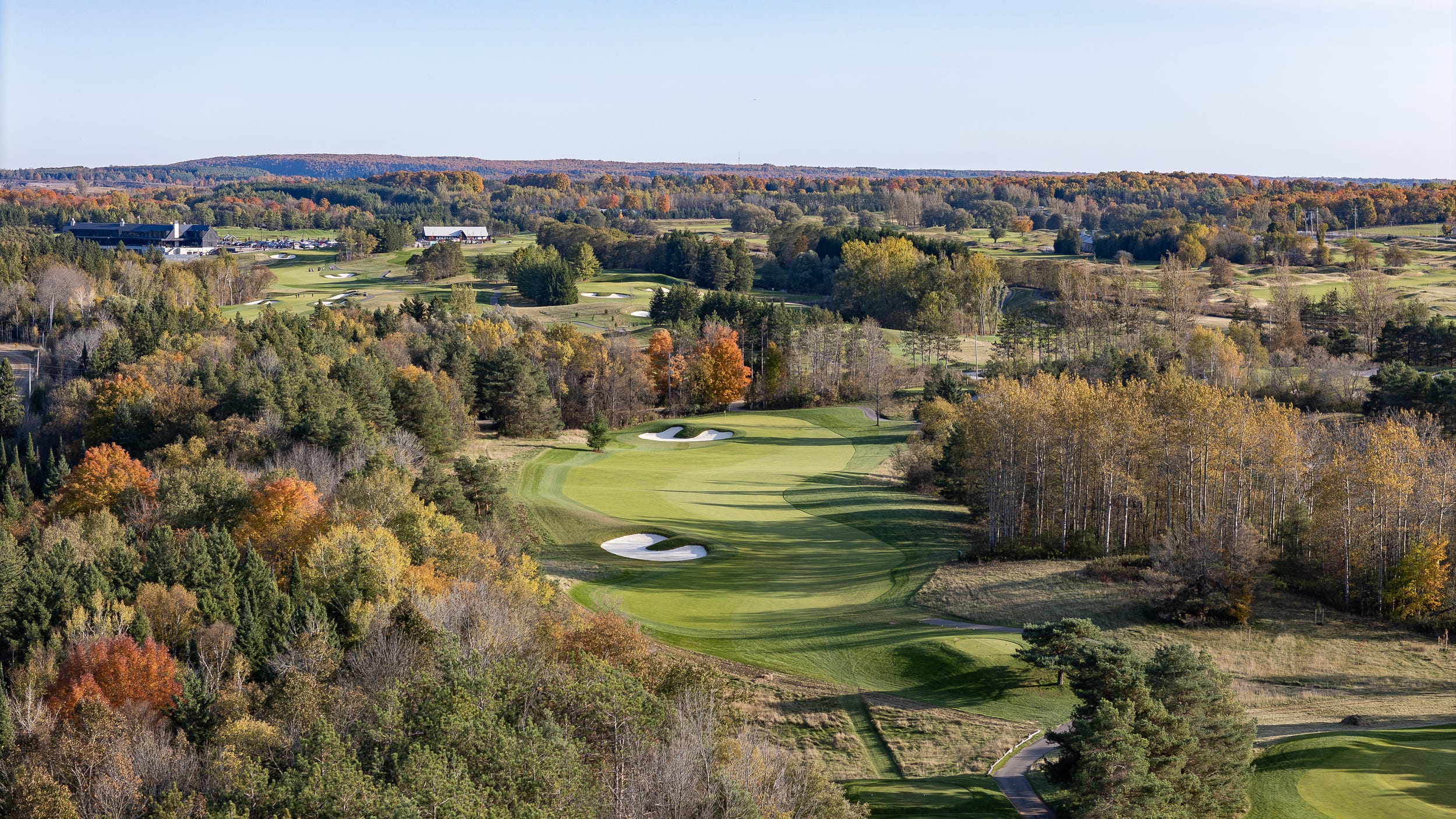
The PGA Tour is heading north to TPC Toronto at Osprey Valley (North Course) for the RBC Canadian Open.
The Canadian Open is the third longest continuously running tournament after The Open Championship and the U.S. Open. It has been played annually since 1904 with just a few cancellations; once due to World I, then World War II, and finally the Covid-19 pandemic.
Early in its history, it was considered one of the most prestigious golf tournaments in the world, but its status began to diminish with the rise of the PGA Tour. By the 1980s, it had declined so much in stature that it was relegated to a September date on the schedule. With the founding of the FedEx Cup in 2007, the PGA Tour schedule was adjusted, and the Canadian Open was moved to early July. The tournament moved to its current position on the schedule during the 2019 reshuffling of the PGA Tour schedule.
Also in 2019, the tournament was added to the Open Qualifying Series, awarding up to three spots in The Open Championship to golfers finishing in the top ten that were not previously exempt.
Despite its long run on the PGA Tour, we won’t have much (or any) course history to work with in most years. In 1976, the Royal Canadian Golf Association decided to make Glen Abbey Golf Course the permanent home of the Canadian Open. The RCGA then reversed its decision in the late 1990s, and the tournament has moved around the country since 2001, playing at a different stop each year but frequently returning to Glen Abbey.
Since the tournament started visiting different courses each year, the scoring has been highly variable. The winning scores only reached -4 and -5 when the tournament was held at Shaughnessy Golf and Country Club. And the scoring maxed out relative to par in 2018 when Dustin Johnson reached -23 at Glen Abbey. Rory McIlroy claimed the lowest four-round total in Canadian Open history at Hamilton, only needing 258 strokes in his victory (by seven strokes). McIlroy was technically the reigning champion when the tournament returned in 2022 after a two-year hiatus and only needed 261 strokes to successfully defend his title.
This year will be a little different because they are returning to the course they played in 2025.
Last year at TPC Toronto, there was a moment on Sunday when 11 golfers were tied for the lead. Sam Burns was able to separate from the pack and head to the clubhouse with the lead at -18. Kevin Yu was able to get within a shot of the lead but couldn’t match Burns. Then came Ryan Fox, who started the day as a co-leader. After making birdie on two of the previous four holes, Fox was within a shot of the lead as he stepped onto the tee of the par-5 18th hole, nearly two hours after Sam Burns had played the hole. He had to lay up on his second shot and then left himself a 27-foot putt for birdie with his wedge into the green. He drained the long putt though to force a playoff. In the playoff, both men made par on the 18th hole three times in a row, but on their fourth time through, Fox put his second shot within 12 feet of the cup to force the action. Burns had a little too much force on a long eagle putt and the comebacker lipped out for a tap-in par. Fox gently lagged his eagle putt to within a foot of the cup. He tapped it in for the second win of his career after winning in Myrtle Beach earlier in the season (cutline: -3; median score for cutmakers: -10)
The Field
The strength of field has always fallen near the middle of the pack since RBC took over the title sponsorship in 2008, buoyed by the stable of RBC ambassadors that are coaxed into playing each year. The Canadian Open saw a drop in the quality of its field a few years ago, likely related to the creation of signature events, and has since been in, or near, the bottom third of all events.
Last year, the strength of field was 273.9 (27th strongest of 46 tournaments; average was 280.1).
The field is set for 145 golfers, with four open qualifiers and one sponsor exemption yet to be determined. Like most non-signature events this season, if Brooks Koepka remains in the field, two additional golfers will be added to accommodate threesomes.
The field is looking a little stronger than it has in previous years. There are four golfers within the top ten in OWGR, including Matt Fitzpatrick, Justin Rose, Collin Morikawa, and Tommy Fleetwood. There are also five more golfers from within the top 25 in OWGR.
By my count, there are 13 Canadian golfers in the field on sponsor exemptions that probably wouldn’t be in the field if not for their nationality.
Here is a link to the full field.
Course Description
Provisualizer doesn’t have a flyover for this venue, so here is a link to the flyover on the club’s website.
TPC Toronto at Osprey Valley is a 54-hole public facility located roughly 40 miles from Toronto in Caledon, Ontario.
Doug Carrick designed all three courses. The first of the three, known as the Heathlands Course, opened in 1992. The other two courses opened a decade later. Originally known as the Hoot and Toot Courses, the Toot Course was, thankfully, renamed the North Course when Osprey Valley joined the PGA Tour’s TPC network in August 2018.
The North Course was built with amateurs and novices in mind. It was just 7,151 yards from the back tees and featured wide fairways. However, in 2023, the course received a complete renovation led by Ian Andrew, one of the architects that worked on the original design, to prepare the course for championship-level competition.
The renovation included building professional tee boxes, altering the fairway lines and tightening the landing zones, a full bunker restoration, repositioning of bunkers and hazards to account for the distance of professionals, removing trees, and enhancements to the green complexes.
On top of the renovations to the course, organizers also had two of the holes that regularly play as par 5s converted to par 4s for the PGA Tour.
After the renovation, the course hosted the Fortinet Cup Championship on the PGA Tour Americas. Will Cannon won the event at -5, one shot better than Sandy Scott.
I haven’t seen any evidence of there being any major changes to the course ahead of the 2026 edition, but I wouldn’t be surprised if organizers make subtle changes to the setup based on lessons learned from last year.
The North Course at TPC Toronto is a 7,389-yard, par-70 parkland design. By par, it is the 7th longest course on tour this season (out of the 38 courses I did calculations for). It was the 31 most difficult course on tour last year (out of the 40 that are ranked by DataGolf).
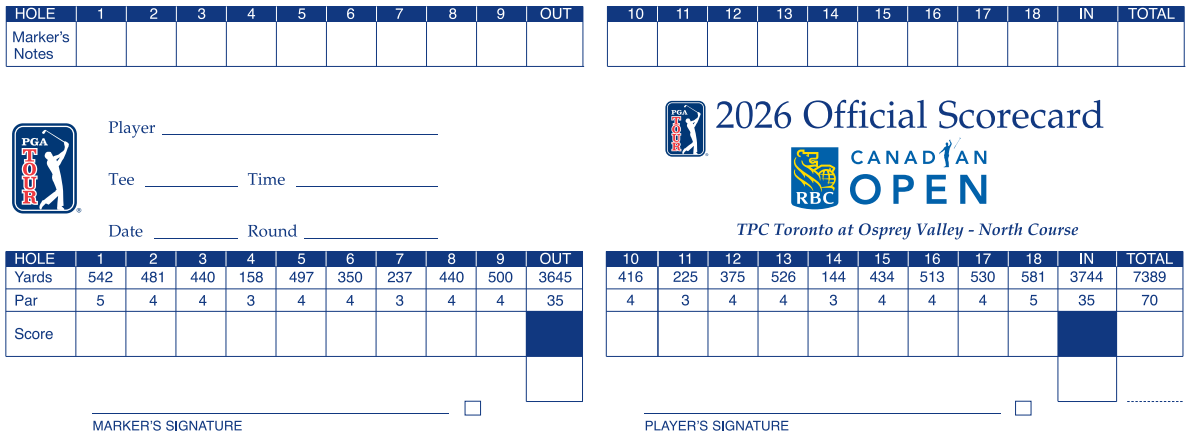
There are four par 3s, twelve par 4s, and two par 5s. The course opens and closes with a par 5 (golfers starting on the 10th hole will play back-to-back par 5s). They were the best scoring opportunities on the course, both giving up birdies about half of the time. There are two short par 3s (144 and 158 yards) and two long par 3s (225 and 237 yards). The shortest of the par 3s was the fourth easiest hole on the course, but both short par 3s played below par. The two longer par 3s played over par. The 350-yard par-4 6th is drivable and was the third easiest hole on the course. There is also a 375-yard par 4 that was the fifth easiest hole on the course. There are four par 4s in the 400-450 range, two par 4s in the 450-500 range, and four par 4s that are 500 yards or longer. An additional five par 4s played under pars for a total of 11 holes that played under par last year.
Here is the official 2026 scorecard:
Off the tee, golfers will see wide, generous fairways. The GCSAA Tournament Fact Sheet lists the average fairway width at 37 yards. There are plenty of trees on the course, but most of them are pushed back away from the fairway and shouldn’t be much of an issue. There are a couple of instances of a singular trees in the corner of doglegs to keep golfers from trying to cut corners. The fairways bunkers are strategically placed where golfers should be aiming for the best angle on approach. They are deep with steep faces and will be a problem for golfers that find themselves in the sand. There is only 25 m between the highest and lowest points on the course, and golfers will climb a total of 75 m during their rounds. Even though there aren’t severe elevation changes, the course designer has used the rolling terrain to their advantage. There are a few holes that play uphill, a few that play downhill, and a few that play over a valley. Where the use of the topography is most notable is in its relation to the bunkers. While golfers will be aiming towards the bunkers in some instances, the fairways are sloped away from the bunker, so that a less than perfect tee shot could end up in the bunker or running away from the desired approach area. Golfers will have to be precise off the tee and be able to move the ball in both directions to access the prime approach areas. The rough is bluegrass that is kept at 3.75 inches in the length. There are also areas of tall fescue throughout the course. The fairways are mix of bent grass and Poa. Water comes into play on three holes.
There are a couple of holes that I think highlight the nuances of the off-the-tee game. The 416-yard par-4 10th hole features a fairway that slopes from left to right. Golfers want to keep their ball to the left side of the fairway for open access to the green, but the slope is working against them. If the ball ends up on the right side of the fairway, the approach has to clear a pond on its way into the green. If golfers are on the left, it’s a very scorable hole. If they are the right, they can play safely away from the pond but will have a long birdie putt, or they can play aggressively to the flag but risk getting wet.
The other hole is the 513-yard, par-4 16th. On this hole, golfers can attempt to carry the bunker on the left, which will give them a wedge into the green if they are successful. A drive that ends up in the bunker or the rough, likely results in a bogey given the length of the hole. The fairway pinches in at the bunker though, so golfers that can’t, or won’t, carry the bunker have to lay up, which will result in a long-iron, or even a fairway wood on the approach.
On approach, golfers will see greens that are above average in size (6,500 sq. ft.) and a mix of bent grass and Poa. Most of the greens are elevated and feature steep drop-offs. There was no Stimp measurement on the GCSAA Tournament Fact Sheet last year, but the Betsperts Course Fact page lists them at 11.5, which is average. Reviews of the course suggest that the greens play firm and fast (though that is the perspective of amateurs). They are protected by deep bunkers, thick rough, closely mowed runoff areas, and water on a couple of holes. When the course was being renovated, the greenside bunkers were placed with the ideal approach location in mind, meaning that if a golfer hits their spot with their tee ball, there will probably be a bunker in their line of approach into the green. There isn’t much undulation or contouring to the greens, so the best defense the greens have is a combination of the risk associated with the hazards and their size. If golfers are able to stick their approaches close to the pin, they’ll have a good shot at making the putt. If they are not positioned correctly off the tee or are unwilling to take on the risk of landing in a deep bunker, golfers will have to settle for a long two-putt par.
We only have one year of data from TPC Toronto, but it is worth looking at, especially since conditions should be similar this year. The average Driving Distance last was 300 yards (10th longest of 40 courses), and golfers used driver 81.4% of the time (compared to the tour average of 70.4%), so golfers took advantage of the wide fairways and weren’t intimidated by any of the trouble off the tee. Probably because it had the 14th highest Missed Fairway Penalty, so slightly penal but not dead. Driving Accuracy was 66.7%, the 4th highest on tour last year. Greens in Regulation was 72.8%, the 6th highest on tour last year. So there really wasn’t much holding anybody back from tee to green. Around the Green difficulty was 25th overall, so there wasn’t much trouble even if golfers did end up missing the green. The only place the course showed any kind of bite was on the greens, which were the 22nd most difficult to putt on. The only thing really holding back scoring, it seems, is the lack of par 5s.
Diving deeper into the Course Table on DataGolf further illustrates how easy this course was. Not only was it the 10 easiest course overall, but it also had the 4th easiest par 3s and the 3rd easiest par 5. It had the third lowest Off the Tee Difficulty and 6th lowest Approach Difficulty. It also had the 5th fewest penalty strokes.
The only thing that seems really difficult is if golfers miss the fairway in a spot other than the rough. The Non-Rough Penalty was the 7th highest, which means don’t hit it in a fairway bunker.
The Weather
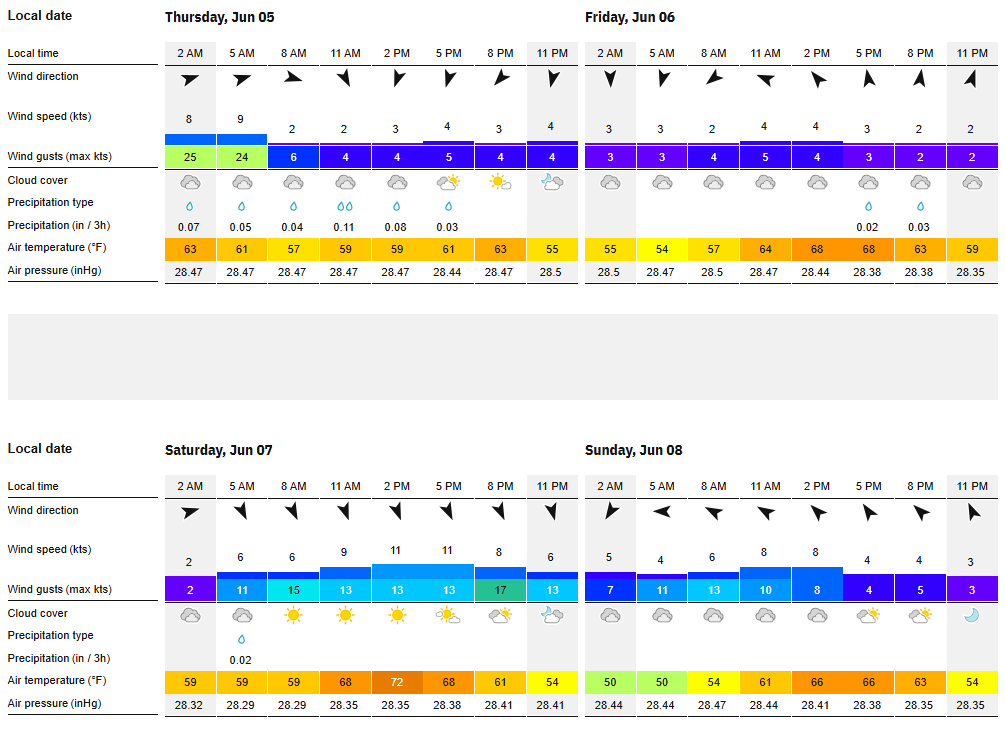
There is at least a little rain in the forecast everyday Tuesday through Saturday this week, so the course will likely be receptive. The winds look like they could be a problem though, so it may not be easy to take advantage of the soft conditions. They are 10-15 mph on Thursday but then they jump up to 20 mph gusts on Friday. The gusts persist until Saturday but begin to drop off in the afternoon. Sunday is a similar pattern with gusts in the morning that subside in the afternoon. Temperatures will top out in the 80s with mostly cloudy skies.
DFS Strategy
As always, the first thing to do is come up with our plan for the week, including bankroll usage, contest selection, leverage, and roster construction. I’ll then go over the type of golfers that I am targeting and the models I’ll use to find those golfers.
Since we’re visiting a course for just the second time, the usual metrics for deciding how much bankroll we want to commit aren’t going to be as telling, but we’ll look at them anyway.
The only winner we’ve had at this tournament is Ryan Fox and given that 11 golfers were tied for the lead at one point on Sunday last year, I would say this tournament is open for anybody to win. That makes it a difficult one to predict.
There weren’t many penalty strokes last year, and the course had the 22nd highest number of reloads. I take this to suggest that the course isn’t very volatile.
The Chalk Report is interesting. Rory McIlroy, the best golfer in the field with 40% ownership, missed the cut. There were also a couple of chalky golfers from the 8ks that missed the cut, but the rest of the chalk performed well. Ryan Fox was the chalk of the 7k range, and a couple of other chalky golfers finished in the top ten. I think we can throw Rory missing cut out, that’s just some weird variance. So, I’d say overall the chalk performed well (just avoid the 8k chalk), which points towards a more predictable outcome.
The slope of the DataGolf Strokes Gained: Total vs. Predicted regression for TPC Toronto was 0.72, suggesting the best golfers in the field were unable to separate themselves. Once again, pointing to the fact that anybody can win this tournament.
I would say when you look at these metrics in totality, they’re indecisive. The chalk performed well, but really the tournament was wide open for anybody to win, which makes it tough for DFS. On the other hand, it’s not very volatile, and nobody will play themselves out of the event on a single hole. I think, therefore, it’s important to look at two other factors.
One, we have only seen the course one other time, so there are still some unknowns. I would totally understand if you wanted to hold back some bankroll until we have more data on the course.
The other factor is that we have the U.S. Open next week and the bigger contests and prizes that come along with it. If you like putting a little extra money down for the majors, holding back some this week isn’t a bad idea.
The RBC Canadian Open is the quintessential run-of-the-mill event on the PGA Tour. DraftKings will still run its full slate of contests though; double-ups, 50/50s, single-entry contests, GPPs, and the Fantasy Golf World Championships and Millionaire qualifiers. I imagine that, because this is a non-signature event at a new course, contest sizes will be smaller than we usually see. If you liked the contests you’ve been playing, they should be available again this week, they just won’t be as big. Remember to check the lobby early in the week; if the contests you usually play are too small for your liking, this will give you enough time to come up with a new plan for the week if you want. Since the chalk performed well last year, I would say that Cash Games are on the table this week.
Once you have decided which contests you will be playing in, we need to decide how much leverage we want and how we’re going to get that leverage.
How much leverage we need this week is a tough call. We only have one prior result to look at, and it was a year in which the highest owned golfer missed the cut. The winning cumulative ownership was 79%. If Rory had played well, I imagine it would have been even higher. The rest of the chalk played well though, so I think we should probably shoot for 80% cumulative ownership, which, as you know by now, isn’t a lot of leverage but it’s not nothing. I doubt any of the golfers in the field will hit 40% ownership, so we shouldn’t drift too much higher. Ultimately, we’ll want to be sure to get some leverage, but we don’t have to go overboard.
As always, we have the same three places we turn to for leverage every week. The first is the ownership projections, where we will try to identify the chalk and then look for good pivots off the chalk. We can also us the projected ownership to figure out what the popular roster constructions are going to be and then figure which constructions will lead to unique combinations of golfers. We can then look at the pricing; identify golfers that are priced too low and consider fading them because they will likely be over-owned and identify the golfers that are priced too high and give them consideration because the DFS community will try to avoid them.
I think, given the length of the course, DFS players will be targeting the bombers. I think the short hitters will struggle to keep up on such a long track, but the mid-distance golfers should be able to keep up with good ballstriking. We should be able to get leverage by fading some bombers and targeting the ballstrikers. The plodders will go overlooked as well, so you should get plenty of leverage if you are bold enough to roster any of them.
Even though the field will likely be average in strength, I still think that the majority of DFS players will be going with stars-and-scrubs lineups. We should, therefore, be able to get leverage with balanced builds. We can also get leverage with super stars-and-scrubs lineups, but I don’t think the field is strong enough to support them.
Once you’ve decided which contests you want to play and how you’re going to get leverage, you can start thinking about roster construction. So, turning to the Roster Construction Matrix, we have a mid-level field on an easy course. In these circumstances, the matrix directs us towards balanced lineups. I actually like both options this week. It may be an average strength field, but the 10k golfers are still solid options. Last year, the winner was kind of a hybrid; it had one 10k golfer and one 9k golfer, but four 7k golfers, so a couple stars and then a more balanced look.
My plan this week is to stick to my usual bankroll and focus on cash games; 50/50s and single-entry contests. I will still enter one of the 20-entry contests, but I will enter a higher proportion of cash games. I will likely build an even split of stars-and-scrubs lineups and balanced lineups. I’ll play the chalk that I like and mix in a few low-owned pivots and golfers with less than 5% ownership and try to keep my projected cumulative ownerships around 80%. I’ll also probably stick with the standard 3-5 ones since I won’t be heading way out on the risk curve.
Now that we have a plan for the week, we can focus on the type of golfers we will target.
The mastermind behind the renovation of the North Course at TPC Toronto said that he hoped to put together a mix of scorable holes, some risk/reward holes, and holes in which golfers have to “persevere.” I think he’s achieved that. There are scorable par 5s and short par 4s, a few long par 4s that will play tough, and some mid-length par 4s that will reward golfers who take on the risk of carrying hazards. It should make for a good all-around test of a golfer’s ability.
Off the tee, golfers will be asked to drive it as far as they can on some holes, play to a certain position on other holes, and the par 3s will test their precision with both short and long irons. Even though there was a high average Driving Distance last year, the Course Fit page on DataGolf also suggests that the course favored accuracy over distance; so, golfers that hit it long and straight had the edge.
On approach, every club from wedges to fairway woods will be pulled from the bag at some point. Almost 50% of approach shots came from 50-150 yards last year, while 25% of approach shots came from over 200 yards.
Around the green, golfers will see tight lies, thick rough, and deep bunkers. And, as usual, golfers will have to make some putts to work their way up the leaderboard.
Golfers will also be asked to regulate their aggression. There are some holes with a risk/reward element that will favor the bold, while other holes will demand golfers be patient and accept par.
As usual, I will start my process by building my Course Fit model and putting together the Recent Form and Course History spreadsheet. I will use my model to target golfers that are strong off the tee with an emphasis on accuracy, are good on approach, particularly with their long irons and wedges, keep it clean around the greens, and are comfortable putting on bent grass.
I will then put together my Predictive model.
We only have one year of Course History to work with, but I will take a look just to get a sense of who played well here. There are also a handful of golfers in the field that played in the 2024 Fortinet Cup Championship, including A.J. Ewart (CUT), Barend Botha (CUT), Matthew Anderson (T23), and John Keefer (T3).
Here are the course fit statistics that I will be using (all from the last 100 rounds):
Off-the-tee:
Strokes Gained: Off-the-tee: A staple in my model week after week; I will use other off-the-tee statistics to fit the model to individual courses. The North Course should test all facets of the off-the-tee game; some holes require distance, others require accuracy, and some require the ability to shape the flight of your ball.
Driving Accuracy: While golfers will be asked to do a little bit of everything, a little extra fire power should come in handy, the wide fairways actually give an edge to golfers that are accurate since they’ll be hitting more fairways overall.
Approach:
Strokes Gained: Approach: A staple in my model week after week. Golfers will have to be precise on approach if they intend to go low enough to contend. As usual, these statistics will be the most heavily weighted statistics in my model.
Proximity 50-150 yards: Almost half of approach shots came from this range last year. Golfers that put their tee ball in the fairway are generally rewarded with a wedge into the green. Golfers that are hitting fairways and are proficient with their wedges should have a big edge.
Proximity 200+ yards: With two par 3s over 200 yards, two par 5s, and four par 4 over 500 yards, about 25% of approach shot will come from over 200 yards.
Around-the-green:
Strokes Gained: Around the Green: Greens in Regulation was high last year, and the around the green play wasn’t too difficult, so I will include this statistic in my model but take some of the usual weight off.
Putting:
Strokes Gained: Putting on Bent/Poa: Putting is another staple in my model; I will switch up the surface as needed. The Rabbit Hole does have a filter for this type of a surface, so we can look for these types of specialists.
Scoring:
Birdies or Better Gained: There are a few holes on the courses that golfers will have to make birdie on to contend and plenty of others where birdie is a possibility. I don’t think this will become an all-out birdie fest, but golfers will need to go low.
Bogey Avoidance: There will also be a few holes where par is a good score and holes where being out of position off the tee could lead to bogey. We want to roster golfers that are adept at saving par when they are in these situations.
Strokes Gained: Total on Long, Easy Course: This week is an interesting mix of long and easy. There are other courses on tour like this where golfers can just mash drivers off the tee and then attack pins with scoring clubs on approach. I want to target the golfers that play well at these courses this week.
Some of the other statistics that I am interested in and will include on the spreadsheet but not in the Course Fit model are:
Stokes Gained: Par 4s 500+ yards: There a four par 4s that can play 500 yards or longer. Golfers don’t need to score on these holes, but if they can breakeven on them after four days, they should be in good position.
Strokes Gained: Par 3s 200+ yards: There are two par 3s that will play over 200 yards. Par should be a good score on these holes, but that isn’t going to be easy.
Strokes Gained: Total in Canada: I’m not sure if there is a particular type of golfer that plays particularly well in Canada, but if there is, I want to target them this week.
In short, I am looking for golfers that are long and straight off the tee, strong with the irons throughout their bag, scramble well, and are comfortable putting on bent/Poa greens. The statistics that I will focus on to start my player pool are Strokes Gained: Off the Tee with an emphasis on Driving Accuracy, Strokes Gained: Approach, Proximity 50-150 yards and 200+, and Strokes Gained: Putting on Bent/Poa.
The statistics that will go into my Predictive model are:
Strokes Gained: Approach
Strokes Gained: Tee to Green
Good Drives %
Birdie or Better %
Opportunities Gained
That’s all I have for now, be sure to follow me on Twitter (@glzisk) for any updates.
Have a great week!