
The Fringe
PGA DFS preview: AT&T Pebble Beach Pro-Am

Good morning, Fringe readers!
This past week at the WM Phoenix Open demonstrated why we should track the weather throughout the week. The forecasts early in the week suggested that winds were going to be light on Thursday and Friday. Then on Wednesday a forecast came out that predicted 40 mph gusts on Thursday morning and had DFS players, including myself, scrambling to build PM/AM wave stacks.
The 40 mph gusts never materialized though and the waves ended up having similar scoring averages.
After watching the weather all week, I should have been more skeptical of the sudden shift in the forecast. In my experience, when forecasts are consistent all week and then we get a drastic change in the final update, the drastic change rarely occurs. I’ve been doing this long enough to know that I shouldn’t overreact to a last minute change, but I did anyway. In the future, I will continue to watch the weather throughout the week and be much more cautious when situations like this last week come around.
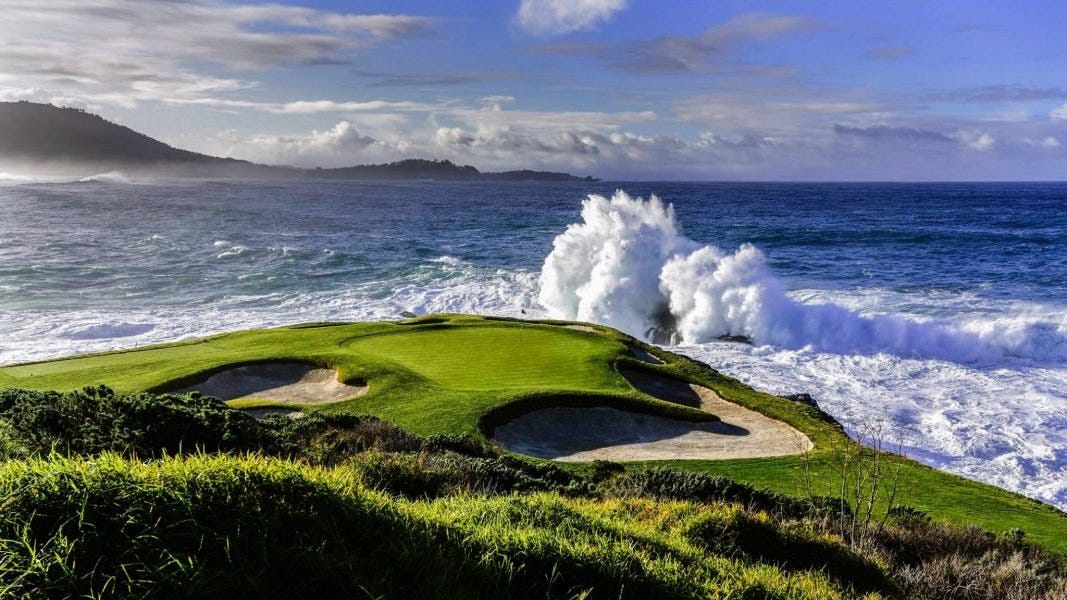
The PGA Tour will head north, and back to the coast, to Carmel Bay and the Monterey Peninsula for the AT&T Pebble Beach Pro-Am, the penultimate event of the West Coast Swing and the first Signature Event of the season.
The AT&T Pebble Beach Pro-Am traces its roots to 1937 when Hollywood icon Bing Crosby came up with the idea of hosting a fun pro-am golf event at Rancho Santa Fe Country Club in Southern California to bring leading pros out in winter, let his show-biz friends play with them, have everybody enjoy a clambake, and raise money for local charities. The idea instantly clicked with players and celebrities alike.
After a hiatus caused by World War II, Crosby moved the tournament north in 1947 to Pebble Beach and the nearby courses on the Monterey Peninsula, where it grew into a PGA Tour staple blending competition and celebrity camaraderie. It also grew into a 54-hole event having previously been a single round event, and adopted a three-course rotation.
The tournament did not become a full 72-hole event until 1958. Under this format, golfers played three rounds with their amateur partners, and the top 25 pairs got to play on Sunday. The most recent three-course rotation of courses, Pebble Beach Golf Links, Spyglass Hill Golf Course, and Monterrey Peninsula Country Club was set in 2010.
Like the other pro-am on tour, The American Express, the tournament took a short break from its standard format in 2021 due to Covid-19 pandemic. There was no pro-am component to the event, no spectators, it was played on two courses (Pebble Beach and Spyglass Hill), and the tournament followed the standard cut rules rather than the usual 54-hole cut. Something to keep in mind when looking at Tournament History.
The tournament was designated a Signature Event for the 2024 season, and the tournament took on a fresh look once again. As a Signature Event, the field was reduced from 156 golfers to 80 golfers. They also eliminated the three-course rotation with the amateurs. Instead, they only play a two-course rotation with their amateur partner on Thursday and Friday. There is no cut for the professionals, but the amateurs don’t get to play the weekend. The tournament then concludes with two rounds at Pebble Beach.
The tournament also uses the same two-course rotation it did during the Covid season, with the Shore Course at Monterey Peninsula Country Club getting cut.
Pebble Beach is usually among the easier courses on tour, while Spyglass Hill is a little more difficult and tends to be towards the middle of the pack in difficulty. The courses are situated on the coast, however, and the wind tends to keep a damper on scoring. During the most recent three-course rotation, the winning score only exceeded 20 strokes under par one time. In 2014, an exceptionally windy third round kept the winning score to just -11. Usually, the winning scores fell between -15 and -19.
Two years ago, Wyndham Clark broke the Pebble Beach course record with a 12-under 60 on Saturday to take a one-shot lead over Ludvig Aberg. High winds and rain kept golfers off the course on Sunday and when play was cancelled again on Monday, Wyndham Clark was declared the winner at -17 (median score: -6). Another good thing to keep in mind when looking at Tournament History.
Last year, the temperatures were chilly, but the wind started out light. They increased throughout the day on Friday and built to 28 mph gusts on Saturday. The wind came down slightly on Sunday, but there were still gusts of 20 mph at times. Sepp Straka was the leader heading into the weekend, sitting three strokes better than anybody else at -14. Straka stalled out on Saturday, shooting -2 on the day, and let Rory McIlroy and Shane Lowry get within a stroke. Straka only managed to shoot even par on Sunday, while Rory put the pedal down, shooting a final round -6 to finish in first place at -21, two strokes better than Shane Lowry (median score: -9)
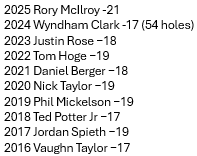
Here are the last ten winners and their scores:
The Field
The field is set for 80 golfers. This is the only Signature Event with a set field size. The 50 golfers that qualified for the BMW Championship and the Aon Next 10 from the FedEx Cup Fall are in the field. The rest of the field will be filled out by the Aon Swing 5 (the top five points earners between Signature Event) and anybody in the top 30 in OWGR after the WM Phoenix Open that is not already exempt. If organizers still need golfers after that, they will pull from the FedEx Fall standings starting with the 61st-place golfer. There are no other qualifiers.
Maybe it’s the pro-am format that has kept the best golfers away, or maybe the Saudi International (usually played the same week) luring them away, but the AT&T Pebble Beach Pro-Am saw a precipitous decline in strength of field in the years prior to it becoming a Signature Event. The strength of the field formerly hovered in the 300s, right around average for the tour. In the last couple of editions before the change, it was in the 100s. The tournament came roaring as a Signature Event though, with a strength of field of 344.8 in 2024 (7th of 43; average was 268). Last year was another good year, with a strength of 344.1 (8th of 46 tournaments; tour average was 280.0)
As a Signature Event with a huge purse up for grabs, the field should be one of the strongest of the season again this year. The field is likely to be even stronger than last year because the world #2 golfer, Xander Schauffele, sat out with an injury. This year, all but three golfers in the top 25 in OWGR have committed to playing. The only golfers missing are Justin Thomas, and two LIV golfers, Tyrrell Hatton and Patrick Reed.
Here is a link to the full field.
Course Description: Pebble Beach Golf Links
The iconic Pebble Beach Golf Links was originally designed by Jack Neville and Douglas Grant for the 1919 opening but has been renovated throughout the years; almost immediately in 1927, in 1998 when Jack Nicklaus re-designed the par-3 fifth hole, and in 1999 when Arnold Palmer began prepping the course for 2010 U.S. Open.
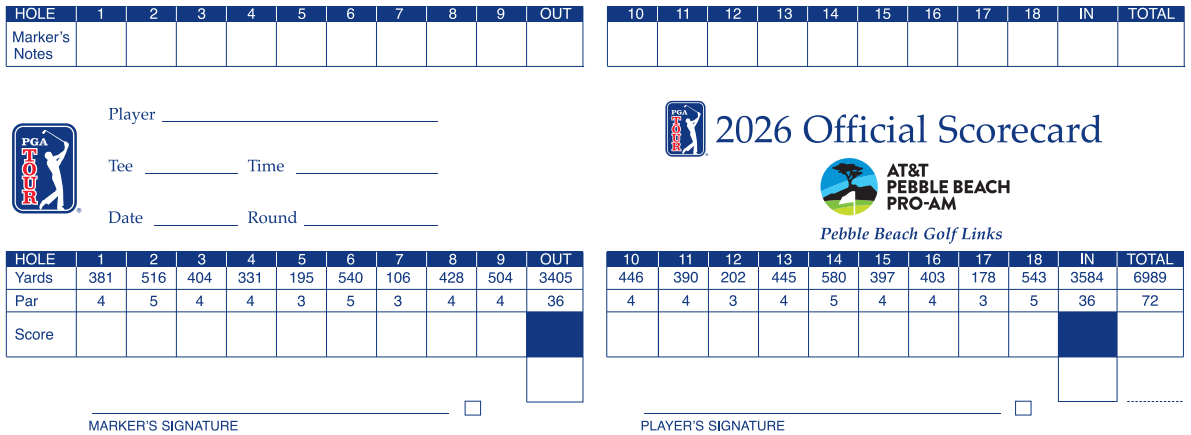
According to the GCSAA Tournament Fact Sheet, the green on the 6th hole was rebuilt and over 50 trees were planted throughout the course ahead of last year’s tournament. This year, the Fact Sheet says that ahead of last year’s edition, the tee box on six was moved and the green on the 10th hole was renovated. I haven’t found any information to clarify the discrepancy, but none of the changes should impact how we approach the course. There was certainly something going on with the 6th hole, however. The scorecard this year indicates that the 6th hole, a par 5, will play 17 yards longer, but still only stretches to 540 yards in length.
Pebble Beach is a 6,989-yard, par-72 classical, coastal design. Last year, it was the 40th longest course on tour and the 26th most difficult, according to DataGolf (out of 41 courses). Only Port Royal in Bermuda is shorter.
There are four par 3s, ten par 4s, and four par 5s. Two of the par 5s are reachable by everybody, one is reachable by longer hitters, and the fourth is tough to reach even for the longest hitters. The two short par 5s are the best scoring opportunities on the course. The par-5 18th was the 4th easiest hole on the course last year. The longest par 5, the 580-yard 14th was the 7th toughest hole on the course and is one most difficult par 5s on tour each year. Not only is it on the longer side, but it plays uphill to a small, two-tiered green surrounded by trees and protected by a large bunker. There is a par 3 that is just about 100 yards in length, and a drivable par 4; both played under par and are the next best scoring opportunities on the course. There are also four par 4s that play at or under par. The rest of the par 3s all played over par, with the two longest par 3s being among the most difficult holes on the course. The most difficult hole on the course was the 504-yard, par-4 9th.
Overall, it can be one of the easiest courses on tour or one of the most difficult, depending on the weather.
Here is the official 2026 scorecard:
Off of the tee, golfers will see fairways that are average in width (29 yards wide at 300 yards) and usually easy to hit. The Ryegrass/Poa annua rough is kept at two to three inches in length. The fairways are also Ryegrass/Poa annua. The landing zones are protected by bunkers (there are 116 bunkers on the course). Although the course features exposure to the Pacific Ocean on 10 of the holes, water only comes into play on one hole. The fairways away from the ocean are tree-lined, and they can become an issue if golfers miss too wildly. There is also the tree in the middle of the 18th fairway that can be a nuisance, even for a well hit drive. Some of the holes have sharp doglegs, forcing golfers to club down. There is a little undulation to the terrain; the overall elevation change is 35 m, and golfers will climb 114 m during their walk.
On approach, golfers will see tiny (3,500 sq. ft) Poa annua greens. They are slow (Stimp= 10.5), and usually soft and receptive. The complexes have just a touch of slope and undulation. They are protected by bunkers, false fronts, and thick rough.
Driving accuracy was 63.1% in 2025 (11th easiest to hit of 41 courses on DataGolf) while Greens in Regulation was 64.5% (18th most difficult to hit of 41 courses on DataGolf). Even though it is easy to keep the ball in fairway, converting that into a Green-in-Regulation is not a given with the smallest greens on tour. Average Driving Distance is 277.0 yards (the shortest of 41 courses on DataGolf). On a short course, with some forced layups, the driver just isn’t needed very much. Strokes Gained: Around the Green difficulty was the 7th easiest on tour and playing from the rough around the greens was 4th easiest (of 41 courses on DataGolf), so a missed green is not necessarily a dropped shot.
According to DataGolf, Pebble Beach was the 2nd most difficult course on tour in Strokes Gained: Approach and the most difficult in Strokes Gained: Approach from over 150 yards. It also has the 4th lowest Rough Penalty and non-Rough Penalty, meaning there is not much of a difference between the number of strokes it takes to hole out from the fairway or rough or areas away from the fairway that are not considered rough. The small greens are challenging to hit whether you are playing from the fairway or rough, so there is not a big penalty for missing the fairway. Golfers can’t get too way off the tee though; Pebble Beach had the fourth most reloads of any course on tour last year.
Course Description: Spyglass Hill Golf Course
Spyglass Hill Golf Course was conceived in the early 1960s by the Pebble Beach Company to serve as a companion championship course to Pebble Beach Golf Links. The name of the course is a nod to nearby Point Lobos, which is believed to have been the inspiration for Robert Louis Stevenson’s novel Treasure Island. Spyglass Hill is where much of the novel plays out, and all of the holes are named after people or places in the novel.
Jones leaned fully into the spirit of Treasure Island by routing the opening holes through rugged, seaside dunes before plunging players into dense Del Monte Forest. During construction, Jones insisted on keeping the tough opening stretch along the coast despite concerns it might overwhelm average players, believing the contrast would define the course’s character.
The course was opened for the 1966 golf season. It was renovated in 1999.
According to the GCSAA Tournament Fact Sheet, the green on the 8th hole was rebuilt prior to the 2024 tournament and the green on the 6th hole was rebuilt prior to the 2025 tournament. Storms in December 2024 knocked down 30 trees on the property, including the famous Cypress tree that protects the corner of the dogleg on the 16th hole. There were also upgrades to the irrigation and drainage systems.
Since last year’s edition, green complex on hole 15 was renovated, increasing the square footage to 1,000 sq. ft. and introducing some new pin locations. The renovation also brought the back bunkers and pond more into play. There have also been 50 trees planted throughout the property.
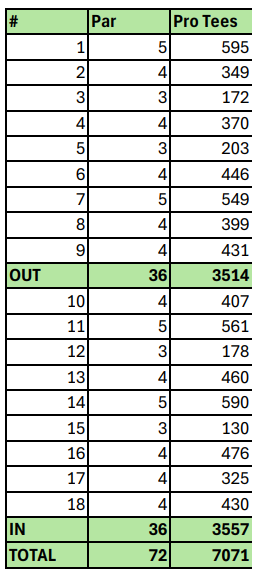
The par-5 14th hole is also 30 yards longer than last year, but I haven’t seen any information of changes made to the hole, so it may just be a matter of which tee boxes they are measuring from.
Spyglass is a 7,071-yard, par-72 that usually plays as the toughest courses on the Monterrey peninsula. Last year, it was the 35th longest course on tour and the 29th most difficult, according to DataGolf (out of 41 courses).
There are four par 3s, ten par 4s, and four par 5s. All the par 5s are reachable and are four of the five best scoring opportunities on the course. There is a drivable par 4 that is the third best scoring opportunity on the course. The only other hole that played under par last year was the 130-yard, par 3 15th. The set of par 3s is also the third shortest on tour.
The official scorecard has not been posted but here are the yardages from the PGA Tour Media Guide:
Off of the tee, golfers will mostly see tree-lined fairways. I have in my notes that the fairways are 32 yards wide at 300 yards on average, but DataGolf has them listed as the narrowest on tour. The first five holes are exposed to the coastal conditions of the Pacific Ocean, but the remaining holes are shielded by the Del Monte Forest. The Ryegrass/Poa annua rough is kept at 3 inches in length. The fairways are also Ryegrass/Poa annua. The landing zones are protected by a smattering of bunkers (65 bunkers throughout) and water on four holes. Wayward drives can also end up with tree trouble. As the name of the course suggests, the terrain is a bit hilly; the overall elevation change is 68 m, and golfers climb 198 m.
On approach, golfers will see small (5,000 sq. ft.) Poa annua greens. They are slow (Stimp=10), and they are usually soft and receptive. They have considerable slope and undulation and are protected by bunkers.
Driving accuracy was 56.1% in 2025 (7th easiest to hit of 41 courses on DataGolf), giving some support to DataGolf listing them as the tightest on tour. Greens in Regulation was 65.8% (19th most difficult to hit of 41 courses on DataGolf). Like Pebble Beach, the fairways are relatively easy to hit, but hitting the green is a little challenging. Average Driving Distance was 283.1 (4th shortest of 41 courses on Data Golf). Strokes Gained: Around the Green difficulty was the easiest on tour and playing from the rough around the greens was 3rd easiest (of 41 courses on DataGolf). While scrambling at either course isn’t overly demanding, I have in my notes that the bunkers are difficult to play from, particularly at Spyglass.
The course is also notable because it has the 5th lowest fraction of missed fairways that result in a penalty stroke. Unlike Pebble Beach, where there is some trouble lurking that could result in a penalty, golfers can be more freewheeling at Spyglass, meaning golfers will use driver a little bit more despite similarly short length of the course.
The Weather
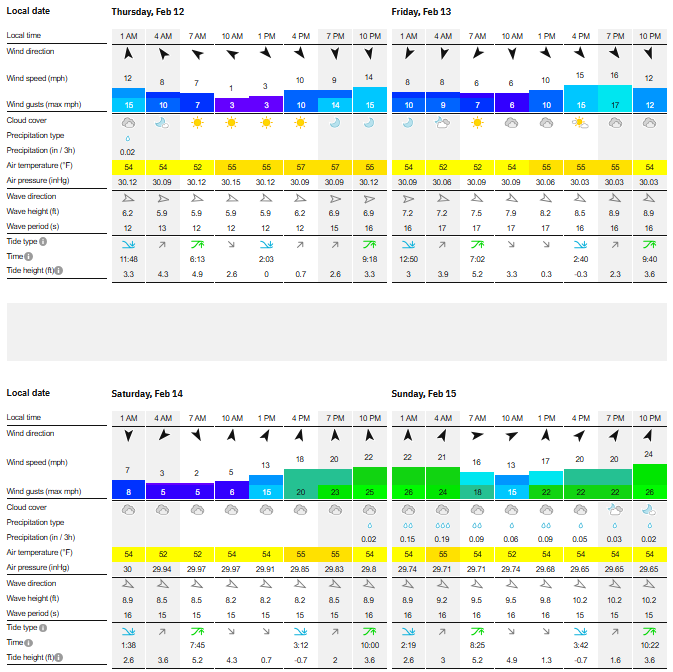
Like other coastal tracks, the weather can play an outsized role in the outcome of the tournament. If winds are down, neither course is very demanding, and a birdie fest can ensue. The wind is usually blowing on the peninsula though, keeping winning scores between -17 and -19.
As of now, the weather forecast for the Monterey Peninsula is calling for temperatures in the 50’s with mostly cloudy skies. The wind on Thursday is forecasted to be around 10 mph. They start out light on Friday then pick up in the late afternoon. The wind could then get cranked up to 20 mph on Saturday and Sunday. There could be a little rain on Friday night and then again on Saturday night through Sunday afternoon.
Even though golfers will go off in one big wave, there will probably be two distinct halves of the wave that flip-flop start times on Thursday and Friday, so we’ll want to pay attention to any possible wave advantage. Once we get to the weekend, however, tee times will be based on leaderboard position and there is nothing we can do about the weather. It doesn’t look like there is going to be a wave stacking opportunity, but that could change be Thursday. The wind will get going over the weekend though, so we will want to look out for wind specialists.
DFS Strategy
As always, the first thing to do is come up with our plan for the week, including bankroll usage, contest selection, leverage, and roster construction. I’ll then go over the type of golfers that I am targeting and the models I’ll use to find those golfers.
At this point, it looks like everybody has made their 2026 PGA Tour debut (except Sungjae Im), so we can cross this off the list of reasons to be cautious with our bankroll.
We do get a new reason to be cautious with our bankroll though, the format of the tournament. Not only will the professionals be playing with amateurs for two days, making for slower rounds and perhaps some frustration, but it is also a small-field, no-cut event. If the unique nature of the tournament has you worried, it’s perfectly acceptable to hold back some bankroll.
It looks like the weather could get cold, wet, and windy over the weekend. When conditions get tough like this, it adds a lot of variance. Even the best struck ball can get gusted and end up in trouble. The wind can make putting more difficult as well. The additional moisture can also mess with lies. This all adds up to lowering the predictability of outcomes, another argument for limiting your bankroll.
Under typical conditions for the Monterrey Peninsula, the courses are medium-difficulty courses, which should usually allow the best golfers to separate themselves from the pack. As I just described, however, typical conditions for the Monterrey Peninsula make the tournament more unpredictable and the best golfers do not necessarily have an advantage, so even though it looks like we’re going to get typical weather for the event, it is not an argument to use our usual bankroll.
The next metric I have been using to determine bankroll usage is how well the chalk performs. Since switching to a Signature Event, the chalk has not performed well at the Pebble Beach Pro-am. Two years ago, just one chalk golfer made it into the top ten. Last year, just two made the top ten, and one of them was a 36%-owned Scottie Scheffler that finished T9. On top of that, the cumulative ownerships of winning lineups of the four contests I usually look at ranged from 54% to 76%, which is on the lower end of cumulative ownerships that I recommend, suggesting that lower-owned golfers performed well. Since the chalk has not performed well the past two years, this makes the tournament less predictable, which is another reason to hold back some bankroll this week.
There is also a high potential for penalty strokes, another factor that adds to the unpredictability to the event.
This all adds up to me recommending holding back some bankroll this week.
DraftKings should have their full slate of contests for this tournament: double-ups, 50/50s, single-entry contests, GPPs, and qualifiers for the Fantasy Golf World Championships. The GPPs and single-entry contests will still be a little smaller than what we see during the height of the season, but they should be similar to what we’ve seen for the WM Phoenix Open, close to the contest sizes that we’ll see when the PGA Tour hits its stride this spring/summer.
Once you have decided which contests you will be playing in, we need to decide how much leverage we want and how we’re going to get that leverage.
The winners of the contests that I usually look at all had a cumulative ownerships under 76%, some of which were below the new cumulative ownership range I am pushing this season (65% to 95%). We’ll want to take on a little more leverage than we have been in the past few weeks and limit our cumulative ownerships to the lower end of the range that I have been recommending.
As always, we have the same two places we turn to for leverage every week. The first is the ownership projections, where we will try to identify the chalk and then look for good pivots off the chalk. We can then look at the pricing; identify golfers that are priced too low and consider fading them because they will likely be over-owned and identify the golfers that are priced too high and give them consideration because the DFS community will try to avoid them.
I think the length of the courses will have DFS players targeting the golfers with good accuracy statistics. Bombers that can successfully club down may go a little overlooked. To go this route, I would just check SG: Total on Courses less than 7,200 Yards for the bombers, and their history at this event. Any bomber that has performed well at short courses, especially the lower-priced bombers, could be good leverage spots.
I also think that DFS players are going to be looking for golfers with a strong Tournament History and avoid golfers with little or no history. I am interested in golfers that have played the event and missed the cut or have not played it all. Both will probably get ignored by DFS players; it’s a gamble but a newcomer may be comfortable with the format, and a golfer that showed up once and missed the cut will be coming in better prepared for the odd format. Check to see how the newcomers did at The Amex, it could be an indication if they can manage the pro-am format.
As with all tournaments based in California, a lot is going to be made about a California connection. The golfers with ties to California could pick up extra steam, making similarly priced golfers good pivots.
We can also get leverage through roster construction. First, I think that most DFS players will go with stars-and-scrubs lineups or even super stars-and-scrubs lineups. Balanced lineups, therefore, will get plenty of leverage. If you’re reluctant to build balanced lineups, you can also go with modified stars-and-scrubs constructions. A popular construction is skipping the 8k or 9k range and loading up on 7k golfers. You can also leave extra salary on the table when building your lineups. Most DFS players try to use all of their available salary, you can get different by not spending all of it; I think $500 to $ 1000 is enough. With all three of these methods, you can still use chalky golfers because you will be putting together unique combinations of golfers and will be less likely to be duplicated.
Once you’ve decided which contests you want to play and how you’re going to get leverage, you can start thinking about roster construction. So, turning to the Roster Construction Matrix, we have a strong field and courses that are usually medium difficulty courses. The matrix points us to a stars-and-scrubs construction. Given the level of talent in the field, it is definitely a viable option. I would also try building some super stars-and-scrubs lineups to see how they look. When the U.S. Open was played at Pebble Beach in 2019, Brooks Koepka, Jon Rahm, Xander Schauffele, and Rory McIlroy all finished in the top ten. Last year, Wyndham Clark and Ludvig Aberg finished first and second, Justin Thomas and Scottie Scheffler tied for 6th, and Patrick Cantlay finished tied for 11th. And, of course, Rory McIlroy won it last year. The winning lineup of the Birdie last year was a stars-and-scrubs lineup. Stars-and-scrub lineups have also tended to dominate the Signature Events.
My plan this week is to pull back a little on my usual bankroll. I will once again be playing the Birdie contest, but I will also build a cash game lineup, for the practice, and put it into a few 50/50s. I will probably go 100% stars-and-scrubs lineups but may mix in a few super stars-and-scrubs lineups. I will limit my use of chalk to five or six chalky golfers. I will aim to keep my cumulative ownerships under 80% but won’t be too concerned if my lineups stray to the bottom end of my recommended range. I will also be using just a few one-offs.
Now that we have a plan for the week, we can focus on the type of golfers we will target.
Both courses in the rotation, Pebble Beach and Spyglass Hill, demand the similar things from golfers; they are short courses with relatively easy to hit fairways (or at least not extremely difficult at Spyglass), short rough, small, Poa annua greens, and the potential for coastal winds. I usually built a single model that encompassed the qualities needed at all three courses. I will do the same this year, but for the two courses being played.
Looking at the list of winners, there are some big names and some lesser-knowns, and a mix of bombers, plodders, and ballstrikers. On short courses with manageable rough, both distance and accuracy are somewhat neutralized, making them second-shot courses. Golfers must be good on approach, whether it is from the fairway or the rough, particularly with their wedges. With the small greens, golfers will also have to be able to scramble to prevent giving back any strokes. They also need to be comfortable on the Poa annua greens.
As usual, I will start my process by building my course fit model and putting together Recent Form and Tournament History spreadsheet. I will use my model to target golfers that are that hit a lot of fairways when clubbing down or can at least hit the green when they are playing from the rough, good with their short irons, can avoid bogeys when they miss the green, and are comfortable putting on West Coast Poa annua.
We are getting to the point where most golfers will have a tournament or two under their belts, and we can start making informed decisions about their form. I will still be cautious with golfers that have only played once, particularly if it didn’t go well. Even though I don’t there are any golfers that haven’t played yet this year (Rory has been busy on the DP World Tour), I will still be on the lookout for them; there is no point in trusting golfers that may still need to knock off the rust (unless, maybe, you are looking for some leverage).
I will give Tournament History a little extra consideration this week. The short, strategic nature of these courses and the unique pro-am format of the tournament give an advantage to golfers that have played here before. I want golfers that have learned to deal with the slow rounds of a pro-am, understand where to place their tee shots for the best approach, and are comfortable on Poa annua greens. The major changes to the courses occurred before most current golfers were playing in the PGA, so you can use all the data you can get your hands on.
Here are the course fit statistics that I will be using in my Course Fit model (all from the last 100 rounds):
Off-the-tee:
Good Drives Gained: Given the length of the courses, and the forced layups, distance is not going to be a huge advantage; given the high Driving Accuracy numbers, I do not think we need to target the accuracy guys either. What will help is being able to hit the green when you miss the fairways. I will look at this statistic on courses shorter than 7,200 yards.
Approach:
Strokes Gained: Approach: A staple in my model week after week. Pebble Beach and Spyglass are second-shot courses, so I will put extra emphasis on the Approach statistics. I will look at this statistic on courses shorter than 7,200 yards.
Opportunities Gained: Hitting these small greens will be critical for producing the birdie opportunities needed to stay in contention. I will look at this statistic on courses shorter than 7,200 yards.
Proximity 75-150: The last data I had my hands one showed that over 22% of approach shots on Pebble Beach come from 100-125 yards out (that is almost double the tour average). Also, given the length of the course, I have to think there will be a lot of short irons and wedges, so I am including the buckets around this range as well. I also have to imagine that these are common ranges on Spyglass too.
Around the Green:
Strokes Gained: Around the Green: Hitting the greens at Pebble and Spyglass is more difficult than the tour average and, while scrambling isn’t too difficult, golfers will need a tidy short game to stay in the mix.
Sand Save %: I have in my notes from last year that bunker play around the green is difficult on the Monterrey peninsula, particularly at Spyglass. I want to make sure anybody I’m rostering doesn’t struggle from the sand.
Putting:
Strokes Gained: Putting on Poa annua: Putting is another staple in my model; I will switch up the surface as needed. This week, I am going to look at putting on Poa annua. The early season West Coast Poa annua plays differently than the Poa annua we see later in the season, so I am going to look specifically at SG: Putting at Riviera, Pebble Beach, and Torrey Pines (South). Also, we should probably give a slight bump to golfers that played the Farmers this year.
Scoring:
Birdies or Better gained: While this tournament is unlikely to turn into a birdie fest, having to reach -20 to get the win is not out of the question. It will also be important to go low if a weather advantage develops. I will look at this statistic on courses shorter than 7,200 yards.
Par 5 Scoring: Both courses have four par 5s. Golfers will need to take advantage of them if they want to get themselves into contention.
Strokes Gained: Total on Courses less than 7,200 Yards: Short courses demand a distinct set of skills than the longer courses do not. I want to make sure that I roster golfers that have proven they can succeed on the short tracks.
After building my model, I usually have a few other statistics that I will look at to help make my determinations. This week, I will look at Bogey Avoidance, Strokes Gained: Total at No Cut Events, and Par 4 Scoring 400-450 yards. Since the forecast is calling for strong winds, I will take a look at Strokes Gained: Total in the Wind.
With small greens surrounded by trouble, golfers will be regularly scrambling for par. If golfers need to get close to -20 to win, not giving any strokes back to the field will be important.
Small-field, no-cut events are still a relatively new feature on the PGA Tour. Until they become closer to the status quo, or we prove prior performance at them doesn’t matter, I want to make sure anybody I roster has performed well at them.
Approximately one quarter of all the holes golfers will play this week are par 4s 400-450 yards length (exact measurements can vary depending on pin location and tee boxes). Golfers better be proficient on these holes if they expect to contend.
I will also build a model that includes statistics that are only available using The Rabbit Hole on Betsperts.com. I use this model to look at specific challenges of a particular course or fill in the gaps of my main model. For Pebble Beach, I will look at Strokes Gained: Off the Tee at Less-than-Driver Courses, Good Drive % on Courses with Small Greens, Strokes Gained: Approach at Courses with Very Difficult, Overall Proximity 50-100 yards, Strokes Gained: Putting on West Coast Poa annua, Par 5 BoB%, and Strokes Gained: Total at Coastal Courses.
The statistics that I will be focusing on to start my player pool are Good Drives Gained Courses under 7,200 yards, Strokes Gained: Approach at Courses with Very Difficult Strokes Gained: Approach, Strokes Gained: Around the Green, Putting on West Coast Poa annua, and Strokes Gained: Total at Coastal Courses.
That’s all I have for now, be sure to follow me on Twitter (@glzisk) for any updates.